

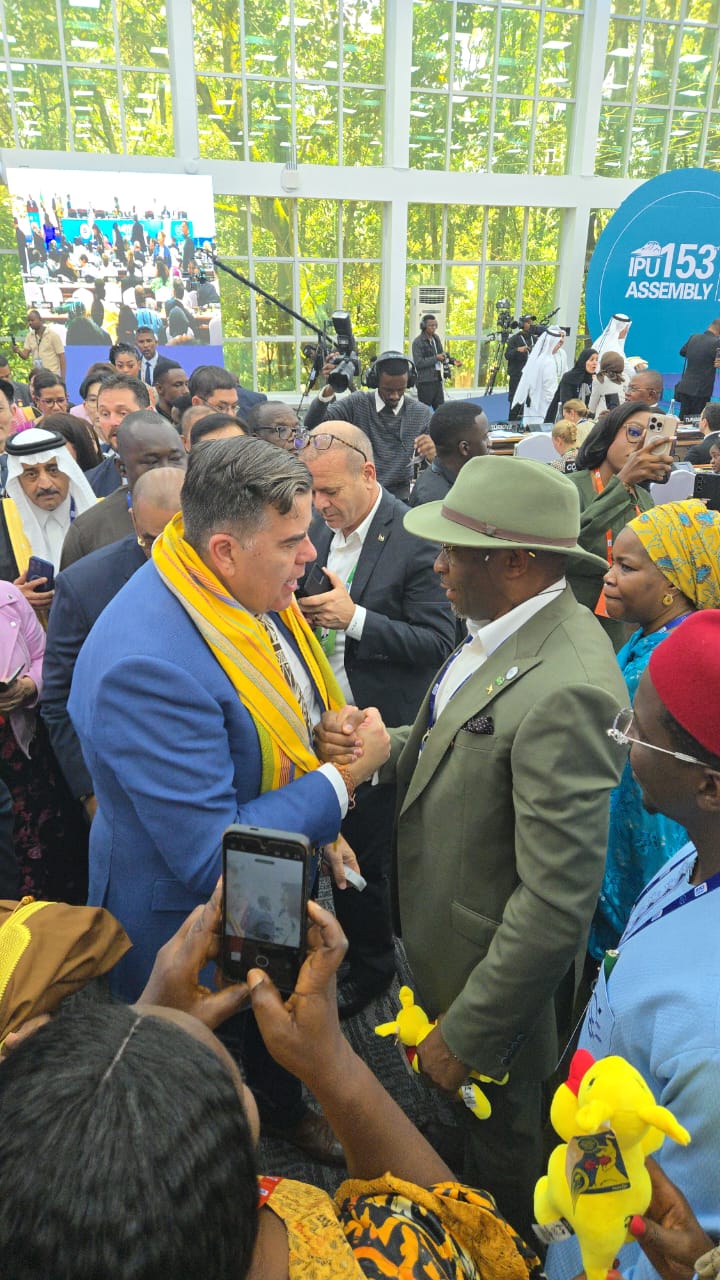
Deputy Speaker of Nigeria’s House of Representatives, Rt. Hon. Benjamin Kalu, has congratulated the newly elected president of the Inter-Parliamentary Union (IPU), Hon. Milton Dick, who is equally the Speaker of Australian Parliament.
Speaking at the 153rd Inter-Parliamentary Union (IPU) Assembly, Kalu also said that Nigeria’s ongoing economic reforms are stimulating growth and improving the ease of doing business.
He also said that inflation has continued to ease with positive spillover in external reserves, stressing that the gains must now be felt in the real economy, particularly in food security and jobs.
Kalu who spoke on the theme “Enhancing Good Governance and Empowering Communities Through Inclusivity, Trust and Opportunities for All” in Arusha, Tanzania, said that Nigeria’s development trajectory under President Bola Ahmed Tinubu, has recorded stronger economic performance in the second quarter of 2026.
He said: “Nigeria’s reforms have lifted growth to 4.43 percent in the second quarter of 2026, and ease of doing business has remarkably improved. Inflation has eased, and external reserves stand above 55 billion dollars, the highest in nearly two decades.”
Speaking on the digital economy, Kalu said participation increasingly depends on digital skills and technological literacy, adding that the National Assembly is investing in young people and equipping them with skills required for the jobs of tomorrow.
The House, he noted, is advancing reforms around data protection, cybersecurity and broadband expansion.
The Deputy Speaker also highlighted legislative priorities in health, saying policies and laws must continually seek to revitalise primary healthcare, expand insurance coverage and grow local pharmaceutical sovereignty.
On security, the Deputy Speaker pointed to the constitutional amendment passed by the National Assembly in June to allow state police and bring protection closer to communities, but cautioned that security alone does not make peace.
“In the drive for food security, mechanisation, irrigation and access to farmer credit must reach rural communities rather than leave them
behind.
“Equally, in a rapidly evolving digital economy, participation increasingly depends on digital skills and technological literacy.
“That is why we are investing in our young people, equipping them with the skills required for the jobs of tomorrow.
“Policies and laws must continually seek to revitalise primary healthcare, expand insurance coverage and grow local pharmaceutical sovereignty, which is what we have been doing in Nigeria in the past 3 years. Policies around these build trust because it is health security through local content.
“In June, our National Assembly passed a constitutional amendment to allow state police and bring protection closer to communities. However, security alone does not make peace. Citizens trust institutions when courts are fair and affordable, and when the powerful answer to the same law as the poor.
“But all of this rests on one condition. There must be a planet tomorrow. Climate change is not a separate agenda item, it is the ground beneath every other agenda item.
“Nigeria calls on every parliament to apply an earth-first lens to every law we pass. Unless we change our approach to the earth, the earth will change every plan we have made.
“These principles continue to guide Nigeria’s development journey under President Bola Ahmed Tinubu, with Parliament reinforcing them through law.
“We have not yet reached our destination, but we have made considerable strides. May our legislation help build trust, create opportunity and guarantee inclusion”, Kalu said.
