

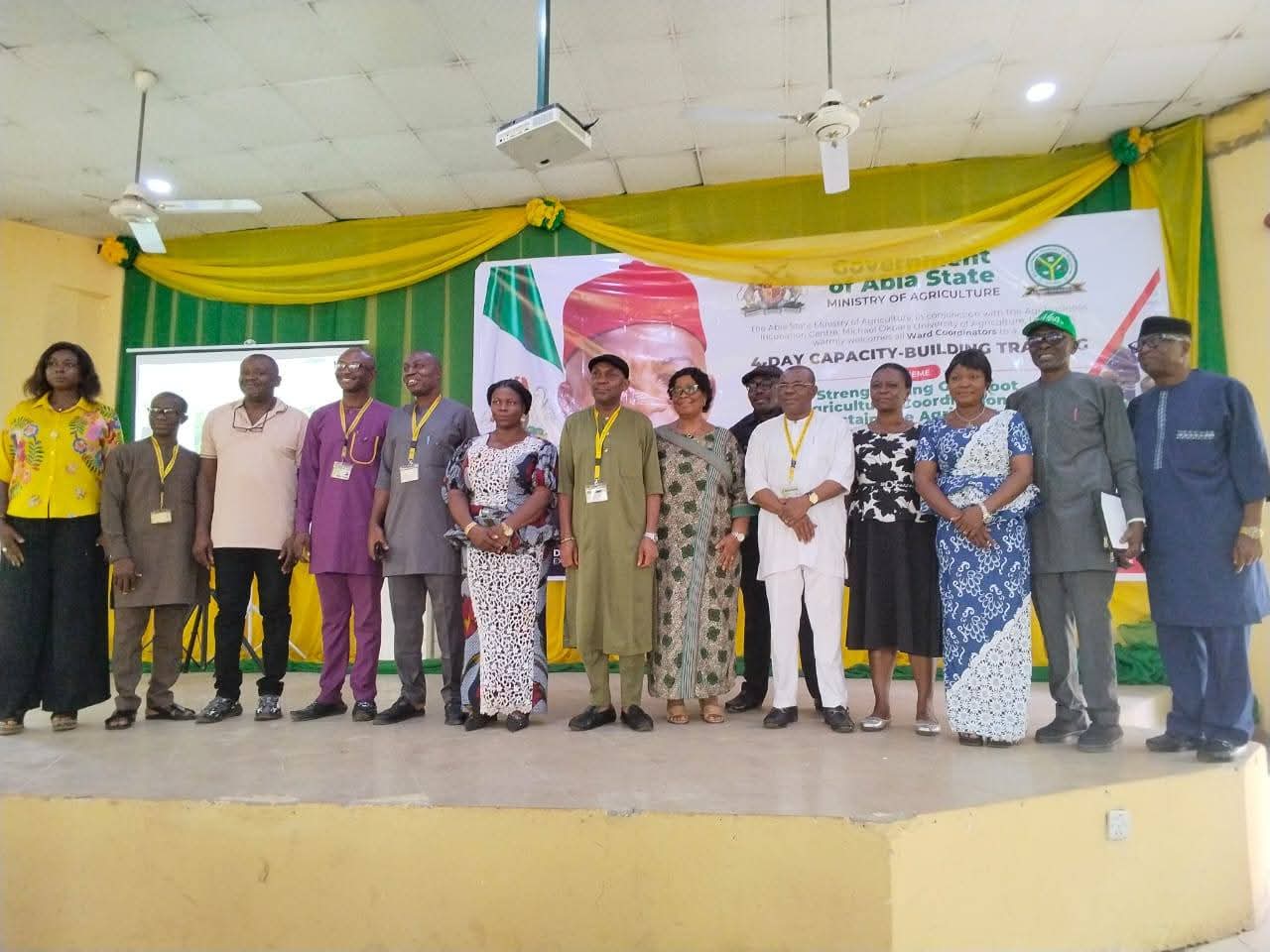
In a strategic effort to strengthen grassroots agricultural development and advance sustainable food production in Abia State, Michael Okpara University of Agriculture, Umudike (MOUAU),in collaboration with the Abia State Ministry of Agriculture, has trained ward agricultural coordinators across the state on modern and sustainable agricultural practices.
The four-day capacity-building workshop, themed “Strengthening Grassroots Agricultural Coordination for Sustainable Agricultural Development,” which is done through MOUAU’s Agribusiness Incubation Centre (ABIC), brought together agricultural coordinators, extension personnel and other key stakeholders to deepen their knowledge of innovative farming techniques, agribusiness development, climate-smart agriculture, value addition and effective agricultural extension services.
Declaring the workshop open, the Vice-Chancellor of MOUAU, Prof. Ursula Ngozi Akanwa, represented by the Deputy Vice-Chancellor, Research and Development, Prof. Princewill Ogbonna, described agriculture as a critical pillar of economic development, food security and employment generation. She noted that the sector was increasingly confronted by challenges such as declining soil fertility, rising input costs, climate variability, inadequate extension services, limited mechanisation, weak market linkages and pressure on agricultural land.
The Vice-Chancellor therefore called for a paradigm shift from conventional approaches to more sustainable and innovative production systems, including organic agriculture, integrated soil fertility management, biological pest control and climate-smart agriculture. According to her, the future of agriculture should not be measured solely by increased yields, but also by the ability to protect the soil, environment and livelihoods of farmers for generations to come.
Also speaking, the Abia State Commissioner for Agriculture, Dr. Cliff Agbaeze, represented by Dr. Ariwodo Ihuanya Stephanie, urged farmers and agricultural coordinators to embrace modern production techniques, stressing that the administration of Governor Dr. Alex Chioma Otti remained committed to strengthening agriculture as a driver of economic growth and food security. He said the state government would continue to support farmers through the provision of agricultural inputs and implements while creating an enabling environment for increased productivity.
The workshop featured intensive technical sessions delivered by seasoned experts who presented lectures on business of farming, climate-smart agriculture, conversion of agricultural waste materials into soil organic fertilizer and agricultural value addition practices.
The participants expressed appreciation to MOUAU and the Abia State Government for the initiative which they described as timely and practical, pledging to transfer the knowledge and skills acquired to farmers in their respective wards and thereby contribute to improved productivity, food security, sustainable livelihoods and agricultural development across Abia State.
