

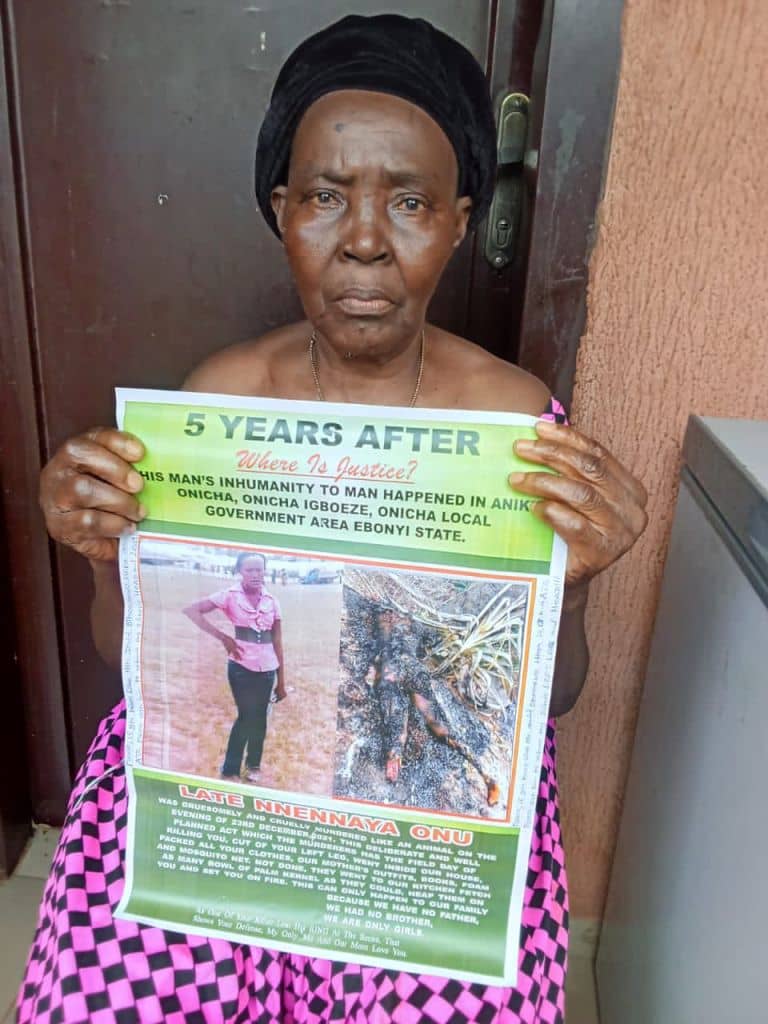
Five years after 35-year-old Nnenna Onu was gruesomely murdered and her body set ablaze in her late father’s compound in Anike, Onicha Local Government Area of Ebonyi State, her aged mother and younger sister are still seeking justice and struggling to overcome the trauma caused by the killing.
Onu was killed on December 23, 2021, in an incident that drew condemnation from rights groups and members of the public. Her family alleged that the murder was connected to a dispute over the inheritance of her late father’s property.
Reports from 2022 established that Onu was attacked at Amagu, Anike, in Onicha-Igboeze, with her body reportedly burnt beyond recognition.
Her left leg was also reportedly severed before the attackers fled the scene. The police commenced an investigation following the incident.
Family sources alleged that Onu, the elder of two daughters, opposed attempts by some members of her father’s extended family to bury him without the consent of his children.
The family claimed that the disagreement was linked to efforts to deny the sisters access to their father’s landed property.
Her younger sister, Juliet Ogonnaya Onu, said the family had lived in fear since the killing. She commended the police for arresting and arraigning Chidiebere Okoro Nwaokorie on March 9, 2026, but expressed concern that other suspects named by the family remained at large.
The family also accused David Okoronkwo Ukpa, popularly known as “ATS”, of being involved in the events leading to the killing.
Ogonnaya alleged that Ukpa had threatened Nnenna days before she was murdered.
She further alleged that Ukpa was recently taken into police custody but was released after denying involvement in the killing.
“Recently, the Police called me and said they had in custody one of the accused persons I consider the prime suspect, Mr David Okoronkwo Ukpa,” Ogonnaya said.
She alleged that the police questioned Ukpa after she made a statement but subsequently allowed him to leave.
According to her, the development has heightened the family’s fear because Ukpa had allegedly remained away from the community since the 2021 killing.
Ogonnaya also alleged that the assailants severed one of Nnenna’s legs after killing her. She said the family believed the act was connected to the threats allegedly made before the murder.
The family has repeatedly linked the killing to the wider dispute over inheritance rights. Earlier reports showed that the family had alleged that relatives forced the female members out of their father’s compound because he had no surviving male child.
The National Human Rights Commission later renewed its call for justice in March 2026, describing the case as involving an alleged inheritance dispute.
Ogonnaya said her mother, who is now elderly, remains deeply traumatised and cannot safely return to her husband’s compound.
She appealed to the Ebonyi State Government, human rights organisations and other relevant authorities to help protect the family and resolve the inheritance dispute.
She also called on the police to conduct a thorough investigation into all allegations and ensure that anyone found culpable faces prosecution.
The family further appealed to the traditional ruler of the community, Eze Ferdinand Okoronkwo Nwujor, and other family stakeholders to help secure the mother’s share of the inheritance.
The case has attracted renewed attention from human rights institutions. The National Human Rights Commission in Ebonyi State called for justice for the family in March 2026 and noted that the killing had generated concern because of allegations that the victim was targeted over her claim to her late father’s property.
Barrister Faith-vin Nwanchor, the State Coordinator of the Ebonyi State Gender-Based Violence Taskforce, condemned attempts to deprive female children of inheritance rights.
Nwanchor said laws protect the rights of women and girls to inheritance and cited the Ebonyi State Violence Against Persons Prohibition Law and relevant Supreme Court decisions as legal safeguards against discriminatory practices.
She commended the National Human Rights Commission, Ebonyi State Ministry of Justice, Human Rights and Conflict Resolution Centre, Ebonyi State Family Law Centre and other organisations that have followed the case.
Nwanchor urged the institutions to strengthen their efforts to secure justice for Nnenna Onu’s family. She also assured the family that the Gender-Based Violence Taskforce would continue to support efforts aimed at ensuring accountability.
All attempts to obtain the reaction of the Ebonyi State Police Command on the current status of the investigation and the circumstances surrounding Ukpa’s release proved abortive.
For Nnenna’s mother and sister, however, the case remains unresolved. Five years after the killing, they are seeking both accountability for the death of their daughter and sister and protection of their family’s inheritance rights.
