

The first section of Nigeria’s Trans-Sahara Highway linking Calabar in Cross River State through Ebonyi State to the northern part of the country has reached about 45 percent completion, Minister of Works Senator Dave Umahi has said.
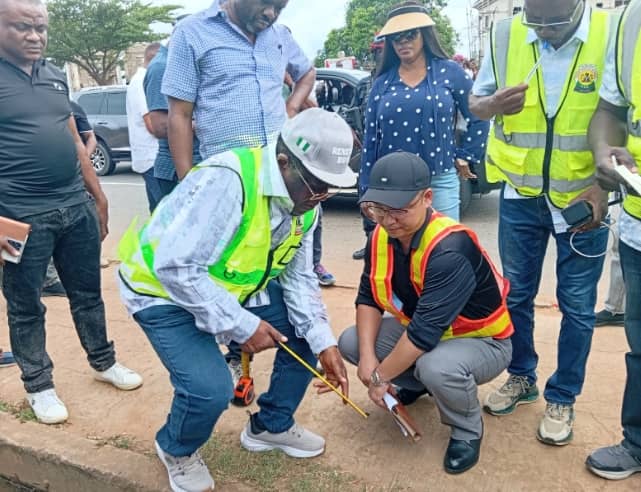
Umahi disclosed this during an inspection of the Calabar-Ebonyi-Benue-Nasarawa-Abuja highway project at Nwedeoga Ndidenyi Ishieke in Ebonyi State. He praised Infiouest International, the contractor handling the project, for the pace and quality of construction.
“Section One is about 40, I will give them 45 percent in completion. The quality of the concrete pavement is top-notch,” Umahi said.
The minister said the project formed part of the Federal Government’s strategic infrastructure programme designed to improve connectivity, strengthen security and expand economic opportunities across the South-East, South-South and North-Central regions.
The Calabar-Ebonyi-Benue-Nasarawa-Abuja Superhighway is among the major federal infrastructure projects being implemented under President Bola Tinubu’s administration. The broader corridor is expected to improve the movement of people, agricultural produce and other goods between southern and northern Nigeria. Recent government information has also identified the highway as a strategic link between Cross River, Ebonyi, Benue, Nasarawa and Abuja.
Umahi said Section One covers about 125.5 kilometres, beginning from the Ndibe Beach axis and passing through communities including Akpoha, Abomege, Amudo and Onueke, as well as parts of Ezza North and Ebonyi Local Government Areas.
He explained that some portions of the alignment were being dualised to accommodate increased commercial activities and urban development. He specifically identified an 8.9-kilometre stretch around Afikpo and a two-kilometre section at Abomege as areas receiving special attention.
The minister said Section Two extends into Benue and other states and has a contract value of approximately ₦683 billion. He added that the Federal Government had already paid 30 percent of the contract sum.
“There is nothing stopping the contractor from working,” Umahi said, indicating that the government expected construction activities to continue without funding constraints.
The second section is part of the wider route designed to connect Ebonyi with Benue, Kogi, Nasarawa and Abuja. The Federal Government previously signed an agreement with Infiouest International for the construction of Section Two, identifying the project as part of its legacy road programme.
Umahi said the completed highway would create a major transportation corridor capable of reducing travel time and supporting the movement of agricultural products, manufactured goods and passengers.
He also said security infrastructure would form part of the project, including CCTV surveillance and solar-powered lighting. The measures, according to the minister, would improve safety along the route and strengthen surveillance on a corridor that connects several states.
Beyond transportation, the project is already generating employment in Ebonyi State. Umahi said Infiouest International had employed more than 2,000 people within the first section of the project.
“Within the first section of the road, Infiouest has employed over 2,000 people,” he said.
The employment includes direct opportunities created by construction activities and wider economic opportunities generated around communities along the highway.
Engineer Mohammed Mustapha, who is in charge of Section One, said the contractor had recorded substantial progress on the alignment. He said construction had advanced from Afikpo towards the Mbeke axis.
“We are almost at 40 percent of the project, starting from Afikpo to reach Mbeke here,” Mustapha said while receiving Umahi during the inspection.
Engineer Rabih Munayyar, who is responsible for Section Two, said the contractor was accelerating mobilisation and construction activities. He identified bush clearing and other preparatory works as some of the activities already underway.
Munayyar also praised Umahi’s technical supervision of the project.
“I have never seen anybody so technically professional. Really, I’m impressed,” he said.
The Acting Controller of the Trans-Sahara Road Project in Ebonyi State, Engineer Maxwell Oko, said the inspection point was located at kilometre 118+300 of Section Two.
Oko said Section One runs from the Ndibe Beach axis through several communities in Ebonyi State and includes major structures such as flyovers at Onueke and Ukwachi Junctions, alongside other bridge projects.
He put the contract value of Section One at approximately ₦454 billion and that of Section Two at about ₦683 billion.
Earlier government disclosures have placed the cost of the first section at around ₦445 billion to ₦454 billion, reflecting changes in the scope and design of the project. The Federal Government has also said the road is being constructed with rigid concrete pavement technology to improve durability.
The Senior Special Assistant to President Bola Tinubu on Community Engagement for the South-East, Barrister Choma Nweze, described the highway as a major economic intervention for communities in the region.
Nweze said the road would improve access to hospitals, markets and other economic centres, particularly for residents in rural communities.
“I’m amazed that every road, every place is being opened up. This will give our women the opportunity of getting to hospital without giving birth on the road. It will make our farmers able to bring their food to town to sell,” she said.
She said the project would reconnect communities across the South-East and neighbouring states while restoring important trade connections.
Nweze also commended the Tinubu administration and the Ministry of Works for executing several major infrastructure projects across the South-East.
During the inspection, Umahi also examined areas where buildings and other properties could be affected by the road alignment. He said the Federal Government was working with relevant authorities to address compensation and resettlement issues.
He commended the Ebonyi State Government for supporting compensation efforts in affected communities, particularly around the Onueke flyover corridor.
The Onueke section has previously been identified as an important component of the broader highway project, with the Federal Government describing the infrastructure as part of its effort to improve transportation and stimulate economic activity in the South-East.
Umahi maintained that the Trans-Sahara Highway would reduce travel time, improve security and create new economic opportunities along the corridor.
Recent Federal Government projections indicate that the completed route could reduce travel time between Ebonyi and Abuja to about three hours, while journeys from the South-South to Abuja could take about six hours.
The minister said the project reflected the Federal Government’s broader infrastructure agenda under President Tinubu and its commitment to addressing Nigeria’s long-standing road infrastructure deficit.
He also urged Nigerians and the media to report the progress of major infrastructure projects accurately, arguing that public discussions about government projects should be based on verifiable facts and figures.
The inspection brought together officials of the Federal Ministry of Works, engineers, contractors, community representatives and other stakeholders involved in the construction of the Trans-Sahara Highway.
With Section One now approaching the halfway mark and more than 2,000 workers engaged, the Calabar-Ebonyi-Benue-Nasarawa-Abuja corridor is emerging as one of the Federal Government’s major ongoing road infrastructure projects in the South-East. Its completion is expected to strengthen interstate connectivity, improve access to markets and support the movement of agricultural products and other goods across the region.
