
By James Udemba
Anyone who was unfortunate to read an article published in Sun newspaper of May 13th, 2026 entitled “The Shadow of 1953 – Why Uzodimma’s Senate Ambition reopens an old wound of South East betrayal”, will have nothing but disdain and pity for those who always resort to the politics of tribalism and religion when intellect and integrity fail them. According to the author whom I will not dignify by mentioning his name, Igbos have always marginalised the South South beginning from 1953 when Prof Eyo Ita was replaced as the premier of the then Eastern Region. He went on to argue that if Gov Hope Uzodimma of Imo State emerges as Senate President in 2027, Igbos would have sustained their marginalisation to the detriment of the unity of the entire South.
I am always amused when some people premise their arguments on faulty generalisation and assumptions based on half truths and innuendos. I am, however, happy that the author of the article admitted that the said ambition of Uzodimma was still in the realm of rumours. Let us leave it at that.
For sometime, enemies of Ndigbo have parroted this obnoxious lie that the Rt Hon Benjamin Nnamdi Azikiwe supplanted Prof Eyo Ita as the premier of Eastern Nigeria when the Western Nigeria parliamentarians ousted him as the rightful leader then, as his party the NCNC had won the majority of seats in the Western Regional Assembly.
That was a misrepresentation of facts. This is actually what happened, a history that could be found in most Nigerian and British archives. Prof Eyo Ita was a distinguished Nigerian educationist and politician from Creek Town, in present-day Cross River State, who was the leader of the Eastern Government of Nigeria in 1951. He joined the National Council of Nigeria and the Cameroons (NCNC) in the 1940s and was elected vice president after the death of Herbert Macaulay, which saw Nnamdi Azikiwe emerging as the new leader of the party. Eyo Ita left NCNC to form the National Independence Party (NIP), which became one of the five Nigerian political parties that sent representatives to the July 27, 1953 London Conference on self determination.
In 1946, the Richards Constitution, which advanced a regional political framework for the country to enhance regional political and economic autonomy, became law. The constitution was made law without the proper consultation of Nigerians, leading to Nnamdi Azikiwe and Eyo Ita opposing the regional political arrangement, while they presented a minority report of a federation of eight states. However, in 1951, the constitution was reviewed with minor changes to the original but opposed by Azikiwe. The major politicians of the time resorted to work within their ethnic and regional base as a foundation to gain political power, this led to regional politics and concentration of power in regional and federal ministers, who were largely nominated by the party and the regional House of Assemblies. In 1951, major elections were held in the Eastern region of Nigeria with Eyo Ita becoming leader of the Eastern government and Azikiwe, leader of opposition in the Western Regional Assembly, a potential obscure position in light of his national repute.
A few federal ministers, however, from the NCNC, supported a trial run of the Macpherson Constitution of 1951, in contravention of Azikiwe’s view of opposition. The ministers had an ally in Eyo Ita. This led to internal wrangling, and a power struggle began, leading to the exit of some of the ministers and Eyo Ita. The new group later formed the National Independence Party, and Eyo Ita later became a member of the movement for the creation of the Calabar, Ogoja, and Rivers State (COR State). He left the movement, however, and re-joined the NCNC in 1956.
What this report shows is that Prof Ita joined forces to rebel against his own master, Azikiwe, who still remained the leader of NCNC. He led the Palace coup, which was crushed. He participated in an insurrection meant to destroy and dethrone his own leader. At the end of the day, he got exactly what was due to his character. He was actually the aggressor, not the victim, the predator, and not the prey. If anyone should talk of betrayal, it is the Igboman who allowed him to be premier in the first place, when there were a surfeit of qualified Igbo to hold that position.
When Michael Okpara took over as the Premier of Eastern Nigeria, his cabinet was dominated by the so-called minorities, including to the Secretary to the Government. Most of his developmental projects, including the imposing Presidential Hotel, were sited in Port Harcourt and Calabar. Although Enugu was the regional capital, Port Harcourt was more developed, industrialised, and patronised as the commercial city. But then, no one talked of marginalisation and reopening of wounds.
Again, I don’t want to delve into what happened during the war. I don’t want to mention the saboteurs. I just want the matter to rest, seeing that God designed Nigeria to be one country with shared destiny. But I can not forget how Eastern Nigeria was balkanised and Igbos, who are the majority, were boxed to East Central state while the minorities had Rivers state and south Easten state. Later, Akwa Ibom and Bayelsa were created to add to the two states to rival South East. No one also talked of marginalisation.
Now, let’s fast forward to 1999 when Olusegun Obasanjo assumed office as president under the People’s Democratic Party (PDP). The author claimed that the Senate Presidency was zoned to the South East and the South South and that the latter ceded it to the former. That is completely false. PDP zoned the Senate Presidency solely to the South East while the South South got the position of Secretary to the Government of the Federation. That was how Chief Ekaette became the SGF. Unfortunately, the people pushing this false narrative will not remember that during the eight years of Buhari, when no single Igboman was appointed a Service chief, the people of the South South enjoyed that privilege. Who was marginalising who? Why was there no wound to be reopened?
Now to the present. The ruling APC zoned the Senate Presidency to the South South and gave the lesser office of Deputy Speaker of the House of Representatives to the South East. We didn’t complain because the APC members from our area are loyal Party members who believe in the supremacy of the party. The South East has also been appreciative of President Bola Ahmed Tinubu’s gesture of appointing our sons as service chiefs and other infrastructural revolutions in our zone. We are contented people.
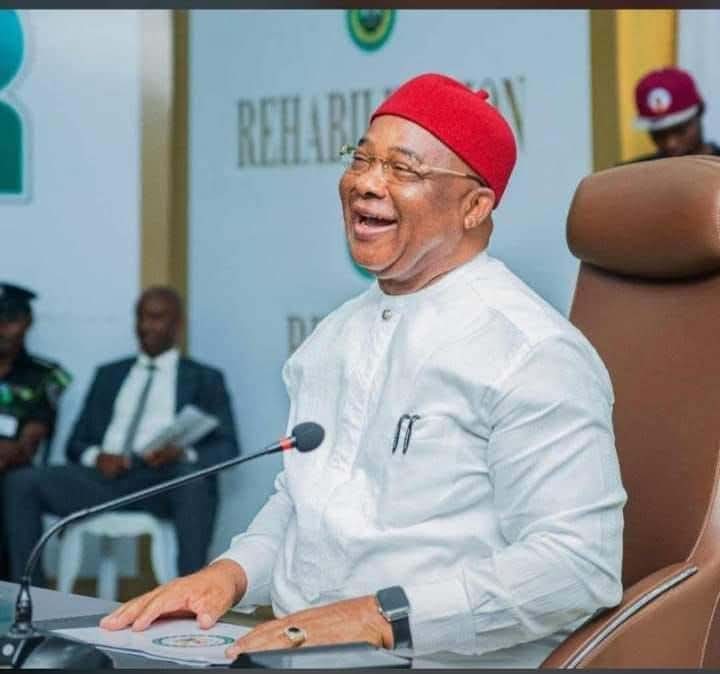
In 2027, the APC will accordingly zone its offices based on the dynamics of the exigencies of the time. If the position of the Senate President is zoned to the South East, it means that whoever is qualified from the Zone, including Senator Hope Uzodimma will vie for it with the support of the leadership of the APC. It will, therefore, not be dependent on hackneyed expressions of marginalisation, victimisation, and fabled reopening of old wounds. Those fanning the ember of tribalism should better be warned to desist from this immoral act or be consumed by it.
Udemba is an Owerri based Public Affairs Analyst.
