





Prince Eze Ugochukwu
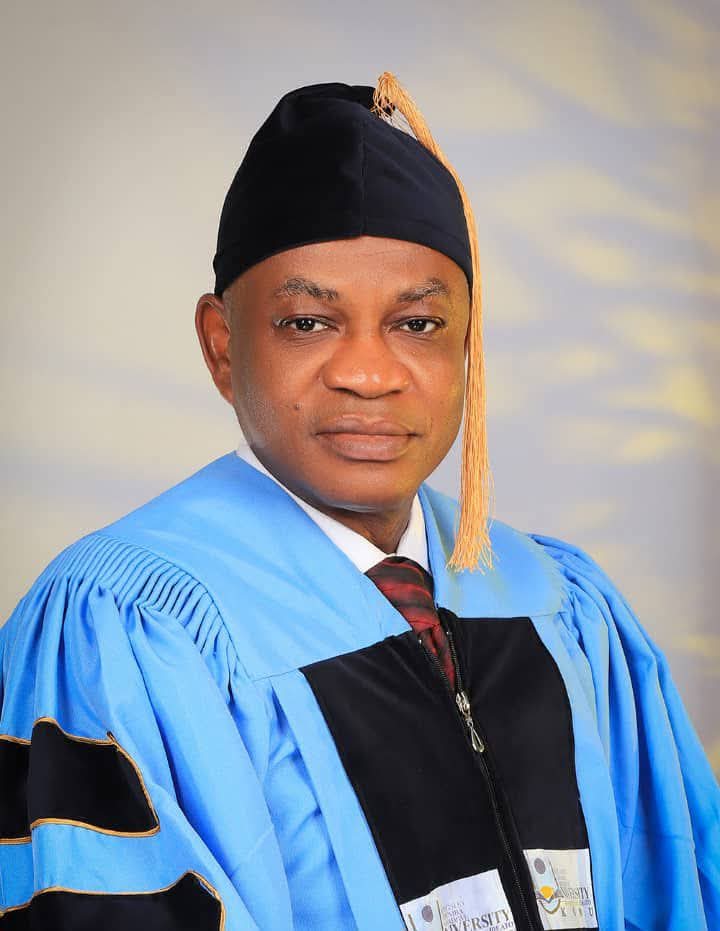
In May 2021, Professor Ikechukwu N.S. Dozie entered the office of Imo State Governor, Senator Hope Uzodimma as an unknown figure. The Governor had no prior acquaintance with him. The institution he had been appointed to lead—Kingsley Ozumba Mbadiwe University (KOMU)—existed only on paper. A reconstituted entity from the defunct Eastern Palm University, the institution functioned with fewer than 300 students, held zero accredited programmes, and operated with a disoriented staff. This fragile situation was further exacerbated by escalating insecurity across the Orlu zone.
On April 15, 2026—four years and eleven months later—Professor Dozie addressed the 3rd and 4th Combined General Assembly. His State of the University Address transcended routine administrative reporting, instead presenting a definitive masterclass in institutional resuscitation. The quantitative gains are striking, yet it is the systemic architecture he engineered that firmly establishes his candidacy for Nigeria’s most senior academic leadership roles.
Three Foundational Pillars of a Globally Competitive Trajectory
Professor Dozie’s tenure is distinguished not merely by growth metrics—a 900% student population increase (from 300 to over 3,000) and a full accreditation leap from zero to seventeen programmes—but by the strategic methodology deployed under severe fiscal constraint. KOMU operates as a non-TETFund beneficiary. Nevertheless, delivery was uncompromising.
First: Governance as Institutional Architecture, Not Individual Authority.
In his address, Dozie highlighted a procedural detail that is, within Nigerian academia, revolutionary: systematic devolution of power and strict temporal discipline. He confirmed that no university meeting or function was ever postponed due to the absence of the chair or presiding officer. Monthly Senate sessions proceed even without the Vice-Chancellor, presided over by the Deputy Vice-Chancellor. Furthermore, a culture of time resource management has been embedded, with Senate meetings commencing at 11 a.m. and concluding by 1 p.m. In a sector notorious for protracted deliberations and leader-dependent paralysis, Dozie has engineered an autonomous operational system. This constitutes the signature of a leader prepared for national coordination—he constructs self-sustaining engines, not personal dominions.
Second: Infrastructure Achievement Without TETFund.
Lacking access to Tertiary Education Trust Fund interventions upon which most public universities depend, Dozie pivoted to rigorous imprest management and strategic partnerships. As documented in his address, the university acquired a new tractor, four moderately used vehicles for principal officers, and leased the Owerri Liaison Office—all funded from grant savings and a modest monthly imprest allocation. Without awaiting government disbursements, he refurbished three abandoned generators, installed solar lighting through the Rural Electrification Agency, and obtained one hundred electronic pads from the Nigerian Communications Commission to advance e-governance. For a sector urgently seeking innovative funding models, Dozie’s approach offers a replicable framework.
Third: Digital-First Transformation—From e-Senate to Google Workspace.
While established universities struggle to digitise student records, Dozie’s KOMU has fully implemented paperless Senate sessions via NCC e-pads, computer-based mid-semester assessments, digitised academic transcripts on the student portal, and Google Workspace for Education enabling real-time collaboration. This represents not incremental progress but a generational advancement. Through partnerships with TD Africa, Huawei Academy, and the AUF-Google Career Certificate Scholarship, Dozie has further ensured that graduates obtain globally recognised certifications in Data Analysis, Cybersecurity, and Project Management—supplementing their degrees with demonstrable professional competencies.
A Leader for Nigerian Education’s Next Epoch
Nigeria’s university system confronts entrenched crises: funding deficiencies, disrupted academic calendars, graduate unemployment, and governance inertia. Professor Dozie’s fourth-year evaluation demonstrates that these challenges are resolvable. His eleven-point Strategic Goals of Action, formulated in 2021, have been systematically realised. He has graduated four cohorts, mobilised them for National Youth Service Corps within six weeks, and launched professional programmes in Medicine, Law, and Allied Health Sciences—all while sustaining a stable, uninterrupted academic calendar since October 2021.
Final Assessment
Professor Dozie concluded his address with a statement that encapsulates his philosophy: “It is not of him that willeth, nor of him that runneth, but of God that showeth mercy.” Yet his address equally testifies to meticulous will, disciplined execution, and strategically harnessed opportunity.
Professor I.N.S. Dozie has already constructed the prototype. He did not merely accelerate progress. He has proven that world-class institutional status is attainable from a standing start—without TETFund, without political patrons, and without recourse to excuses. Only a blueprint, a cohesive team, and an unyielding commitment to “One Team. One Mission. Selfless Service to Humanity.”


