




Prince Eze Ugochukwu
There is a pattern emerging that is too consistent to be dismissed as coincidence. Not long ago, Imo was in the news for crises that felt manufactured, scripted, meant to wound.
Now?
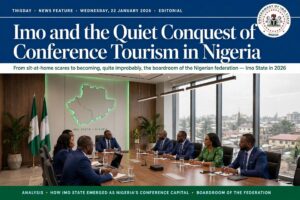
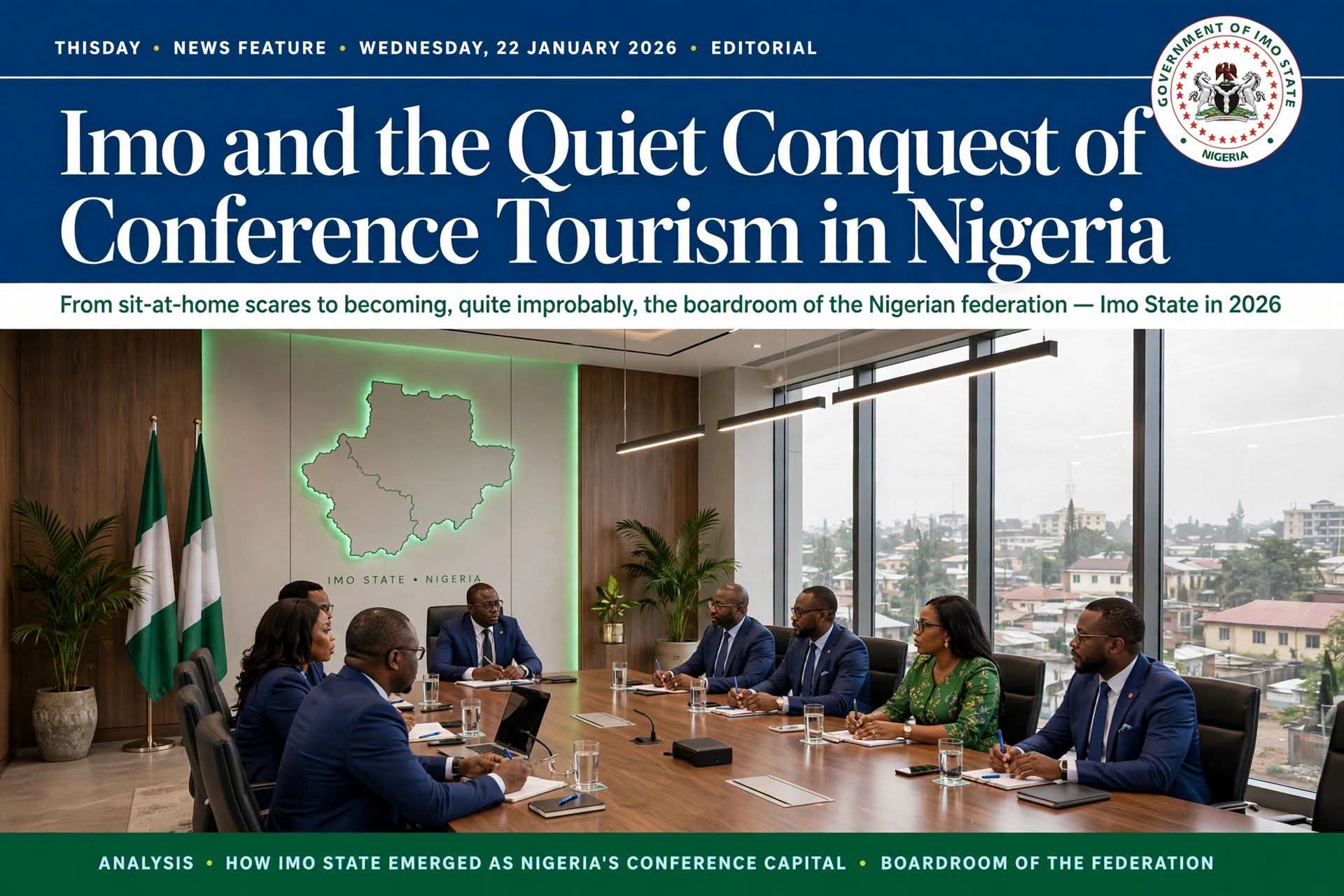
The same state has somehow become Nigeria’s default boardroom — the place where some of the country’s most consequential gatherings are happening.
Sometime in mid-August, I received a call from a friend who is a Commissioner for Finance in one of the South-West states. He was in Owerri. Not for politics, not for a private visit, but for the National Council on Finance and Economic Development, NACOFED.
For those who understand how this country’s public finance architecture works, NACOFED is not a small gathering. It is where the Minister of Finance, the Accountant-General of the Federation, all 36 Commissioners for Finance and Accountants-General, chairmen of Internal Revenue Services and heads of all major revenue agencies come to argue over FAAC, revenue and survival strategies.
For the first time in its history, that council chose to meet in the South-East, and it chose Owerri. The venue was the Chief Emmanuel Iwuanyanwu International Convention Centre, EIICC, and the dates were August 16 to 19. The symbolism was not lost on anyone.
But that was only the beginning.
Barely a week later, the same Owerri hosted the Nigeria National League, the NNL, for its 17th Annual General Meeting. Thirty-four clubs, NFF President Ibrahim Gusau, General Secretary Mohammed Sanusi — the entire second tier of Nigerian football — converged on Imo. The COO, Danlami Alanana, was effusive in thanking Governor Hope Uzodimma, but the point is larger than football. The NNL had just left Kaduna the previous year; they came East because they believed the infrastructure would hold.
Then came faith and culture. From August 19 to 22, the Catholic Church in Nigeria brought its 16th National Choir Conference, NACAMCON, to Owerri. Choristers, music directors, chaplains from all nine ecclesiastical provinces gathered at Assumpta Cathedral and Owerri Girls Secondary School under the theme “Echoes of Faith; Restoring the Timeless Voice of Catholic Worship.” If you have ever attended a NACAMCON Mass, you know it is not a small parish affair. It is a national liturgical summit.
And then, September arrived with a different kind of weight.
From September 10 to 13, the University of Nigeria Alumni Association held its 112th National Executive Council Meeting and 28th National Convention in Owerri. Over 150 delegates from across the federation arrived, went on excursions to Shekinah British International School in Ihiagwa, paid homage to HRM Eze Okwudiri Divine Nwandu, and held a live radio session on Zanders FM. That an association so intimately tied to Nsukka would choose Owerri for its convention tells you something about accessibility and hospitality.
A week later, the state turned into a fortress of uniforms. The 6th Conference and Retreat for Senior Police Officers, CARSPO, took place at two locations, the Emmanuel Iwuanyanwu International Conference Centre and the Landmark Event Centre from September 21 to 23, later extended to the 24th. This is the third time Imo is hosting CARSPO, and that repetition matters. The theme — “Developing a Nigeria Police Roadmap for Effective Management of Security During Elections” — drew the Inspector-General of Police, Olatunji Rilwan Disu, all AIGs, CPs, election experts, INEC officials, and even the Presidency, with President Bola Tinubu, represented by the SGF, Senator George Akume, declaring it open.
Mr. Shina Philips of Lenders Consult International, who has partnered the Police since 2019, put it well: when senior police officers, journalists, experts and service providers converge on a state, they do not come empty-handed. They sleep in hotels, eat in restaurants, use transport, buy data, and in the process, they audit the host state’s capacity. Imo passed that audit three times.
And even golf has found its way into the story. The most unlikely of conferences happened not in a hall but on a green.
From September 8 to 12, the Arsenal Golf and Country Club in Obinze — that quiet club hosted what they called the Governor’s Cup 2026, themed “Swing and Discover the New Imo.” It was, on paper, just a three-day golf tournament. In reality, it was a gathering of businessmen, retirees, professionals, club captains from across the country, and politicians who traded agbadas for polo shirts. The Local Organising Committee chairman, Sir Ernest Nwapa, spoke ambitiously of a five-year plan to make Arsenal a West African golf tourism destination, and he was not joking — about 55 corporate sponsors put their money behind it.
Governor Uzodimma himself showed up on September 12, not just to watch but to swing, and then did what governors often do best at such events: he announced money. A hundred million naira to complete the club’s ongoing building project. He called golf “not just a social event but a physical fitness event and a point of contact for connection of businesses,” which is true. Anyone who has watched deals being struck between the 9th and 18th holes knows that Nigeria’s most important boardrooms are often not boardrooms at all.
That Owerri could host NACOFED and CARSPO and still make room for a Governor’s Cup on the same weekend tells you something — Imo is no longer just hosting people, it is keeping them busy after the communique has been issued.
And if you still think this is only about government councils, consider what happened last week.
On Wednesday, September 24, Interswitch — yes, the same Interswitch that could choose Lagos, Abuja, or anywhere else for its flagship industry series — chose to open its TechConnect 6.0 in Owerri. Not Lagos. Owerri. At Protea Hotel. The theme was “Built for What’s Next: Designing Adaptive Financial Infrastructure for a Dynamic Market,” and the audience was not your regular political crowd: bankers, fintech founders, technology executives, revenue administrators. The keynote was delivered by Justice R. Okoye, Executive Chairman of Imo State Internal Revenue Service, alongside Finance Commissioner Chuck Chukwuemeka, both speaking about how a state’s tax system can become digital, connected, and resilient. For Interswitch, Owerri was not an afterthought; it was the first stop in a national tour that will later go to Abuja, Ibadan and Lagos. When Africa’s biggest payments company decides that the conversation about the future of money should start in Imo, that is not just event planning. That is market confidence.
The other event is even more telling because it is homegrown. The same week, Imo Government held a Town Hall for its One Kindred, One Business Initiative — OKOBI — the community enterprise model that the Vice President, Kashim Shettima, has now endorsed as a national template. It was not held in some hall with plastic chairs. It brought together 65 community-owned businesses that have completed risk assessments and are ready for CAC registration, out of nearly 600 OKOBI businesses with over 20,000 members now operating across the state in poultry, piggery, palm oil processing and other local skills. Deputy Governor Chinyere Ekomaru, representing Governor Uzodimma, reminded them that incorporation is only the beginning; sustainability is the test. Prof. Kenneth Amaeshi, the Chief Economic Adviser who spoke about the model around the Igbo philosophy of Igwebuike, explained how kindreds are pooling resources to become corporate entities. And that, perhaps, is the second leg of this surge. Owerri is not only hosting Nigeria’s national conferences; it is exporting its own local economic model to the federation, with the Federal Government now adopting OKOBI to tackle youth unemployment.
If you thought that was all, you missed the quieter but perhaps more significant ones. In the same month, the Body of Federal and State Auditors-General held its 55th Bi-Annual Conference in Owerri, starting September 29, with the theme “Safeguarding Public Resources and Enhancing Citizen Trust: The Strategic Role of Auditors-General.” Auditors-General from all 36 states and the Federation gathered, and Governor Uzodimma, who declared it open, challenged them to find courage. It is rare to see the custodians of public audit choose a state that is not Abuja or Lagos.
There was also the 2026 Public Lecture of the Federal Polytechnic, Nekede on September 23, which became a national conversation on law and higher institution administration, chaired by former Speaker Goodluck Opiah, and the commemoration of World Patient Safety Day by the Imo Health Ministry at MacDon Skye Hotel.
What then is happening?
It is easy to attribute this to Governor Uzodimma’s personal networking. There’s nothing wrong with that. But networking alone does not sustain a surge. What I see is a deliberate pivot from a politics of lamentation to an economy of hosting.
Imo has invested, perhaps more than any South-East state in the last three years, in conference infrastructure. The EIICC is now a 6,000-capacity international convention centre that can compete with Abuja’s International Conference Centre. The Landmark Event Centre has become the go-to for security and corporate retreats. There are hotels, yes — and this is critical — there are road networks within Owerri city that allow for movement between venues without the chaos of Lagos.
In other words, Imo is selling peace. In a country where organizers are increasingly nervous about where to safely gather finance commissioners or 200 or more senior police officers, perception is everything.
The true test of a state is not how many allocations it receives but how many others are willing to entrust it with their national conversations. By that test, Imo in 2026 has done more than just host conferences. It has made a statement: that the Eastern Heartland, long described as volatile, can be the most neutral ground for Nigeria to talk to itself.
And that, perhaps, is the real conference dividend.


