




…a Chronicle of Parliamentary Diplomacy
By Sam Hart
There is a certain kind of representation that begins at home but refuses to be confined by geography.
It begins with a constituency, in this case, Bende Federal Constituency in Abia State, but expands into the national arena, across Africa and ultimately into the rooms where legislators from around the world debate peace, trade, development, security and the future of multilateralism.
That is the international parliamentary journey of Rt. Hon. Benjamin Okezie Kalu, Ph.D, CFR, Deputy Speaker of the House of Representatives of the Federal Republic of Nigeria.
Bende’s representative in Nigeria’s National Assembly has, particularly since becoming Deputy Speaker of the 10th House in June 2023, accumulated responsibilities across some of the principal forums of parliamentary diplomacy. He has served in the ECOWAS Parliament and Pan-African Parliament, participated in the Inter-Parliamentary Union and, in February 2025, was invited to join the Steering Committee of the Parliamentary Conference on the World Trade Organization. The latter was particularly significant because his appointment is Nigeria’s first representation on that global parliamentary trade panel.
Records of Hon. Kalu’s international engagements is not simply a catalogue of foreign trips. It is a progression, from participation to responsibility, from making interventions to helping frame international parliamentary discussions and, eventually, to serving as co-rapporteur of a resolution adopted by the Inter-Parliamentary Union.
GENEVA, MARCH 2024: TAKING AFRICA’S TRADE CHALLENGES TO THE WTO
One of the early markers came in March 2024 when Kalu joined Nigeria’s delegation to the 148th Assembly of the Inter-Parliamentary Union in Geneva, Switzerland.
The Assembly, held from March 23 to 27, focused on parliamentary diplomacy and the building of bridges for peace and understanding. The IPU’s official records confirm Kalu’s participation as Deputy Speaker of Nigeria’s House of Representatives.
But his Geneva engagement extended beyond the Assembly hall.
During a visit to WTO Director-General Dr. Ngozi Okonjo-Iweala, Kalu raised the practical obstacles confronting African primary-product exporters. He drew attention to difficulties involving product standards and aflatoxin contamination and sought greater WTO collaboration to improve market access for Nigerian and African products.
There was a broader philosophy behind that intervention: international engagement should ultimately connect to the economic circumstances of citizens at home.
At the same IPU Assembly, Kalu also argued for changes to the Union’s procedures for admitting emergency items. His position was that the existing mechanism could limit the ability of African crises to receive sufficient international parliamentary attention. He raised conflicts affecting Sudan and other African countries while also addressing the humanitarian situation in Gaza and advocating greater gender inclusion in governance.
The pattern was beginning to take shape: participate in the international institution, but also challenge its processes where those processes appeared insufficiently responsive to African concerns.
MIDRAND, 2024: FROM NIGERIA TO PAN-AFRICAN REPRESENTATION
By June 2024, Kalu’s parliamentary responsibilities had expanded further with his entry into the Pan-African Parliament, the African Union’s legislative organ.
That placed him in an institution designed to bring African legislators into continental policymaking and integration.
In September 2024, at the 12th Annual Conference of Speakers of National and Regional Parliaments held at the Pan-African Parliament in Midrand, South Africa, Kalu used the continental platform to draw attention to catastrophic flooding in Borno, Adamawa and Yobe States.
He told fellow African parliamentary leaders that more than $200 million would be required to address the humanitarian consequences and reported that more than one million people had been displaced in one affected state. He connected the disaster to the broader African challenge of climate change and called for continental solidarity.
The intervention produced a tangible parliamentary response: the Conference of Speakers subsequently expressed solidarity with Nigerian flood victims and other Africans affected by similar natural disasters.
At the same gathering, Kalu advanced proposals linked to the African Union’s Agenda 2063, including subregional centres of excellence in technology, innovative financing mechanisms and stronger public-private partnerships for infrastructure development.
Nigeria’s immediate humanitarian concerns had therefore been placed within a larger argument about Africa’s resilience, infrastructure and long-term development.
NEW YORK, FEBRUARY 2025: REIMAGINING MULTILATERALISM
February 2025 marked another stage.
At meetings connected to the Inter-Parliamentary Union at the United Nations Headquarters in New York, Kalu argued that the architecture of global multilateralism required reform.
Representing Nigeria at a meeting of parliamentary leaders preparatory to the Sixth World Conference of Speakers of Parliament, he called for greater representation of developing countries in international decision-making and argued for Nigeria’s inclusion as a permanent member of the United Nations Security Council.
He also questioned aspects of the UN funding structure, arguing that excessive dependence on a small number of major donors could create imbalances in international priority-setting.
During the IPU-United Nations Parliamentary Hearing in New York, he participated in discussions on financing the Sustainable Development Goals and the international debt crisis, presenting Nigeria’s fiscal experience within that wider global conversation.
Then came an institutional milestone.
On February 12, 2025, IPU Secretary-General Martin Chungong invited Kalu to join the Steering Committee of the Parliamentary Conference on the WTO.
The appointment was the first time Nigeria would be represented on the panel.
This was more than attendance at another conference. It gave Nigeria a place within a continuing parliamentary mechanism connected to international trade governance.
The WTO Steering Committee comprises representatives of IPU member parliaments, the European Parliament and other international organisations and meets with WTO leadership and trade diplomats to examine developments in the multilateral trading system.
For Nigeria, that meant another channel through which its legislative voice could engage global trade policy.
MIDRAND AGAIN: A FINANCIAL LEADERSHIP ROLE
Days later, another responsibility followed.
On February 25, 2025, Kalu was appointed Chairman of the Pan-African Parliament’s Committee on Monetary and Financial Affairs after the West African caucus backed his nomination to complete the tenure of the previous chair.
The appointment placed a Nigerian legislator at the head of one of the continental parliament’s important economic committees.
At the time, Kalu was simultaneously chairing the Finance and Administrative Committee of the ECOWAS Parliament while participating in the IPU and its WTO parliamentary architecture.
The significance lay in the convergence of these responsibilities: subregional finance through ECOWAS, continental monetary and financial affairs through PAP, and international trade through the IPU-WTO parliamentary process.
TASHKENT, APRIL 2025: FROM SPEECHES TO GLOBAL POLICY FORMULATION
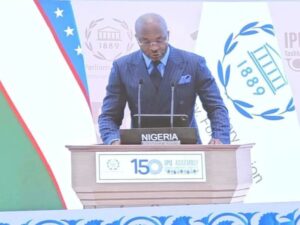
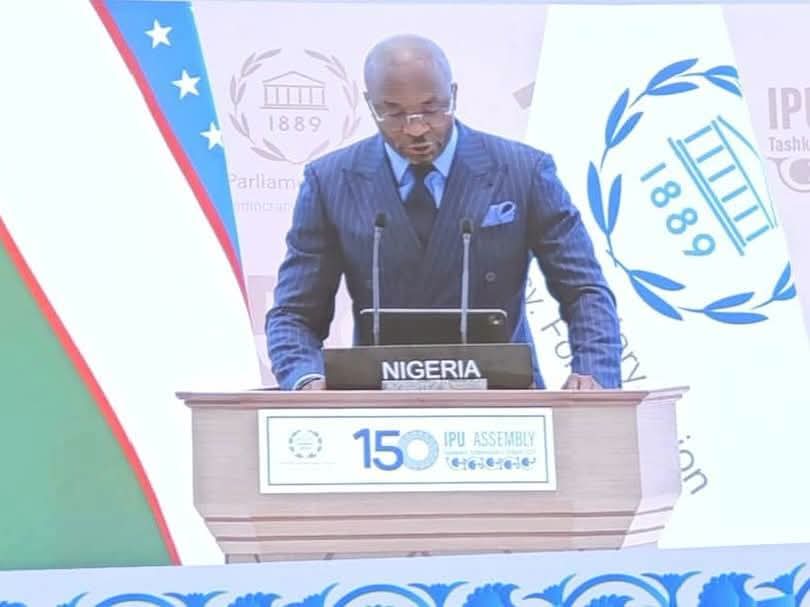
The 150th Inter Parliamentary Union Assembly in Tashkent, Uzbekistan, in April 2025 became another important point in this trajectory.
Kalu was the head of the Nigerian Delegation at an Assembly whose general debate centred on “Parliamentary action for social development and justice.”
Kalu used the occasion to discuss Nigeria’s legislative interventions in social development and to call attention to Africa’s debt burden and its consequences for investment in human development.
More consequentially, he became involved in the IPU’s work on post-conflict recovery.
As co-rapporteur within the Standing Committee on Peace and International Security, Kalu advanced proposals for stronger post-war management frameworks, drawing particular attention to conflict-affected African countries including Sudan and the Democratic Republic of Congo.
His argument was that peace agreements alone are insufficient. Sustainable peace requires functioning institutions, economic reconstruction, social reconciliation and sustained international support.
That work would not end in Tashkent. It would eventually mature into something considerably more enduring. We’ll come to that later.
BRUSSELS, JUNE 2025: RETHINKING AFRICA-EU ECONOMIC RELATIONS
In June 2025, Kalu led a Pan-African Parliament delegation to engagements with the European Parliament in Brussels.
There, his emphasis shifted towards the structural economic relationship between Africa and Europe.
He advocated what he described as “near-shoring”: bringing technology and industrial capacity closer to the African locations from which raw materials originate.
The argument was straightforward. Africa possesses substantial raw materials and a large young population; Europe possesses capital, technology and industrial expertise. Instead of perpetuating a model in which African commodities are exported in raw form and finished products imported back at greater value, industrial activity could be located closer to African resources.
Kalu linked such a model to value addition, employment creation and the reduction of economic pressures contributing to irregular migration.
Security featured as well. During the Brussels engagements, he advocated an African-led security framework supported by Europe, rather than solutions dominated by external intervention. He also proposed more regular institutional engagement between committees of the Pan-African Parliament and European Parliament to strengthen implementation and accountability.
Again, the recurring theme was African agency: partnership rather than dependency.
GENEVA, SEPTEMBER 2025: DIGITAL TRADE AND THE NEW ECONOMY
By September 2025, Kalu was back in Geneva for the WTO Public Forum and the 55th Session of the Steering Committee of the Parliamentary Conference on the WTO.
His intervention addressed “Promoting Multilateralism Through Digital Trade: What Role for Parliaments?”
Kalu argued that digital trade had become a central governance challenge, affecting entrepreneurs and the economic opportunities available to young people. He pointed to the African Continental Free Trade Area and its Protocol on Digital Trade as evidence that Africa was developing its own architecture for regional digital integration.
He connected those international discussions to domestic legislation, including Nigeria’s Data Protection Act and work on digital-economy legislation.
The underlying proposition was increasingly clear: parliamentary diplomacy should not exist in isolation from domestic lawmaking. International agreements require national legislation, appropriations, oversight and implementation.
That is where parliaments matter.
YAOUNDÉ, MARCH 2026: MAKING THE CASE FOR FAIRER GLOBAL TRADE
By March 2026, Kalu’s position within the Parliamentary Conference on the WTO had advanced from participant to rapporteur.
Ahead of the WTO’s 14th Ministerial Conference, the Parliamentary Conference met in Yaoundé, Cameroon.
Kalu was one of the rapporteurs for the substantive debate on “Fairness and development for all through global trade.”
His discussion paper challenged participants to look beyond the conventional question of whether trade is free and consider whether the international trading system is genuinely fair.
The paper argued that despite decades of global trade liberalisation, prosperity remained unevenly distributed. From an African perspective, Kalu placed industrialisation and value addition at the centre of the debate.
It was the maturation of an argument he had been developing since his earlier WTO engagements: Africa should not remain principally a supplier of unprocessed commodities to the international economy.
ISTANBUL, APRIL 2026: FROM CONTRIBUTING TO DEBATES TO SHAPING A GLOBAL RESOLUTION
Perhaps the strongest institutional evidence of Kalu’s growing role in international parliamentary work came in Istanbul in April 2026.
At the 152nd Assembly of the Inter-Parliamentary Union, he served as co-rapporteur alongside parliamentarians from Jordan and the Netherlands on a resolution addressing the role of parliaments in post-conflict management and the restoration of just and lasting peace.
The subject had been developing since the Tashkent Assembly a year earlier.
In Istanbul, it reached the floor.
Kalu presented the draft framework, which was subsequently adopted following deliberations by IPU members. The framework placed emphasis on five broad areas: institutional strengthening, equitable economic reconstruction, social reconciliation, inclusive political participation and sustained international support.
The adopted resolution emphasised national ownership of recovery processes and a stronger role for legislatures in designing legal frameworks, overseeing reconstruction and ensuring accountability.
Here, parliamentary diplomacy had moved beyond speeches and interventions.
A Nigerian legislator had participated directly in developing an international parliamentary framework intended to guide legislatures across IPU member countries in approaching societies emerging from conflict.
GENEVA, SEPTEMBER 2026: FROM GLOBAL DISCUSSION TO ACCOUNTABILITY
The journey has continued.
At the 57th Session of the Steering Committee of the Parliamentary Conference on the WTO in Geneva in September 2026, Kalu pressed for concrete progress on food security and investment facilitation.
He also proposed a mechanism through which participating parliaments would report the specific actions taken in their jurisdictions to advance previous WTO and Parliamentary Conference outcomes. His argument was that international meetings should increasingly be connected to measurable domestic accountability.
At the same meeting, he called for WTO capacity-building programmes for parliamentarians to be extended to Nigeria.
The engagement also produced an indication of what may come next: the IPU leadership reaffirmed its commitment to working with Kalu towards the proposed hosting of a Parliamentary Conference on the WTO event in Abuja in 2027.
FROM BENDE TO THE WORLD
Taken chronologically, the record reveals an expanding sphere of parliamentary responsibility.
Geneva placed African trade barriers on the table.
Midrand connected Nigeria’s climate emergency to continental action.
New York provided a platform for arguments about reforming multilateralism and increasing African representation.
Tashkent moved his engagement into the drafting of approaches to post-conflict recovery.
Brussels provided a platform for a different model of Africa-Europe economic partnership.
Geneva brought digital trade into focus.
Yaoundé elevated him to rapporteur on fairness and development in the international trading system.
Istanbul saw a post-conflict parliamentary framework on which he served as co-rapporteur adopted by the IPU.
And Geneva in September 2026 returned the emphasis to implementation, food security, investment and parliamentary accountability.
The progression matters because parliamentary diplomacy is sometimes mistaken for ceremonial travel. Properly practised, it is something different: the projection of national interests, the exchange of legislative ideas, negotiation across jurisdictions, coalition-building and the conversion of international discussions into domestic legislative action.
Kalu’s international engagements provide several documented examples of that model in practice.
His parliamentary identity today consequently operates at several levels: representative of Bende Federal Constituency in Nigeria’s House of Representatives; Deputy Speaker of the House; participant and Committee Chair in West African parliamentary integration through ECOWAS; participant and committee leader within the Pan-African Parliament; contributor to the Inter-Parliamentary Union; and member of the Steering Committee of the Parliamentary Conference on the WTO.
From a constituency in Abia State, the platforms have become progressively larger.
Bende.
Nigeria.
West Africa.
Africa.
The global parliamentary community.
And across these platforms, one principle runs through the public record:
The legislator who travelled to Geneva in March 2024 raising practical questions about African exports was, two years later, serving as a rapporteur on the fairness of the global trading system and as co-rapporteur of an IPU resolution on post-conflict recovery.
That progression tells its own story.
From Geneva to Midrand; from New York to Tashkent; from Brussels to Yaoundé; from Istanbul back to Geneva, Benjamin Okezie Kalu has increasingly carried Nigerian and African questions into international parliamentary rooms: How can trade become fairer? How can Africa add value to what it produces? How should the international system respond to conflict? How can post-war societies rebuild? How can Africa secure greater agency within multilateral institutions? And how can parliamentary declarations be converted into accountable action at home?
These are not merely Nigerian questions.
They are African questions.
Increasingly, they are global questions.
And therein lies perhaps the most important dimension of parliamentary diplomacy: the ability of a legislator elected by a defined local constituency to carry the concerns, experiences and aspirations of that constituency’s country and continent into conversations far beyond its borders.
From Bende to Abuja.
From Abuja to West Africa.
From West Africa to Africa.
From Africa to the world.
Ben of Bende.
A Nigerian voice in the global parliamentary community.
Bende, behold your gift to Nigeria, West Africa, Africa and the world.
He is still on duty. Send him back to Abuja to do more.
Sam Ifeanyi Hart, a Member of the National Institute, is Chief of Staff to Rt. Hon. Benjamin Okezie Kalu and travels with him on his international engagements.


