
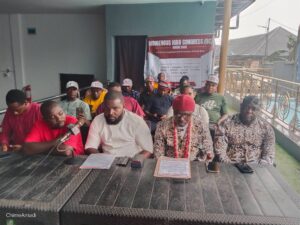




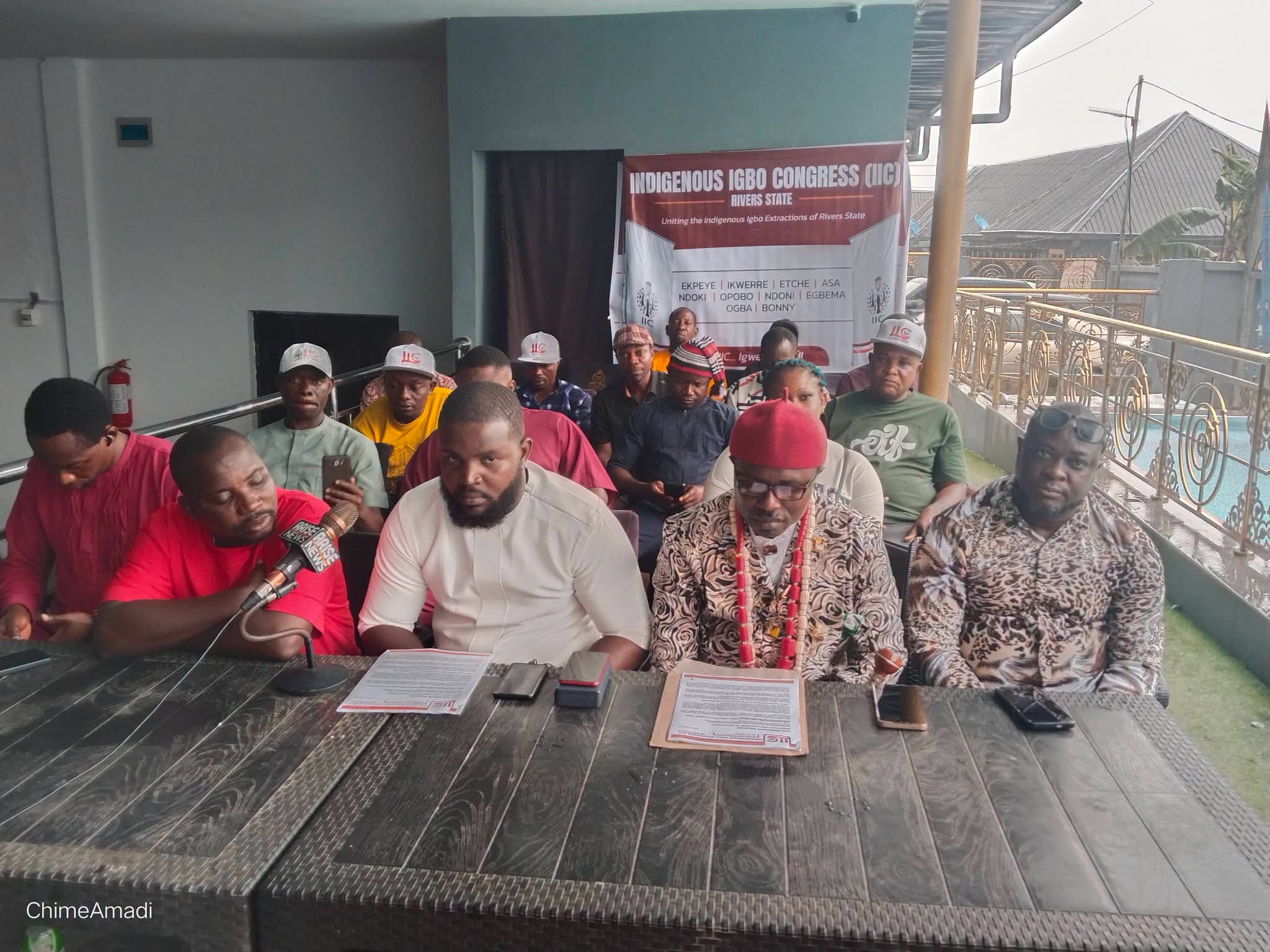
The Indigenous Igbo Congress (IIC) of Rivers State has declared its opposition to what it termed a selective application of ethno-linguistic regionalism in the proposed restructuring of Nigeria.
The IIC, in a communique signed by its President, Comrade Chimenum Amadi (Ikwerre); its Vice President, Comrade Azubuike Okere (Ndoki); and Comrade Dimma Iworiso Ojimba (Okirika), its Director of Communication, demands a single, undivided Igbo Region inclusive of the Igbo-speaking peoples of the Rivers frontier.
Explaining itself, the Indigenous Igbo Congress said that it is a movement pioneered by the indigenous Igbo-speaking peoples of the administrative confines of Nigeria known as Rivers State.
IIC said it exists to preserve the ethnocultural and linguistic identities and integrity of the Igbo groups at the frontiers, firstly in Rivers State itself.
According to IIC, among whom it counts the Igbo-speaking, which includes Ikwerre, Etche, Ekpeye, Ọgba, Ndọni, Ndọki, Asa and Egbema, together with the populations of Bonny and Opobo, who are both Igbo-speaking and historically of Igbo descent.
IIC said that beyond Rivers State, its movement embraces the other Igbo frontier areas, communities scattered, like seed corn across alien administrative fields, by the harsh realities of the unfavourable federalism in Nigeria.
The group lamented that Igbo communities were placed inside other administrative entities, where they were manufactured into minorities and pressured to surrender their existence as Igbo.
“We name them because a people that cannot be named cannot be defended: Ọhaobu-Ndọki in Ukanafun LGA, Akwa-Ibom State; Umuezekoha in Benue State; Akpanya and Eke-Avurugo in Kogi State; Igbanke on cutting across Edo State; Isobo in CrossRiver State; and Abuetor and Osekwenike in Bayelsa State. These are our people.”
IIC said that the fathers of the above-mentioned clans bore Igbo names, spoke Igbo words, and were buried in Igbo ground and were not moved from their homes, but their homes were moved from around them.

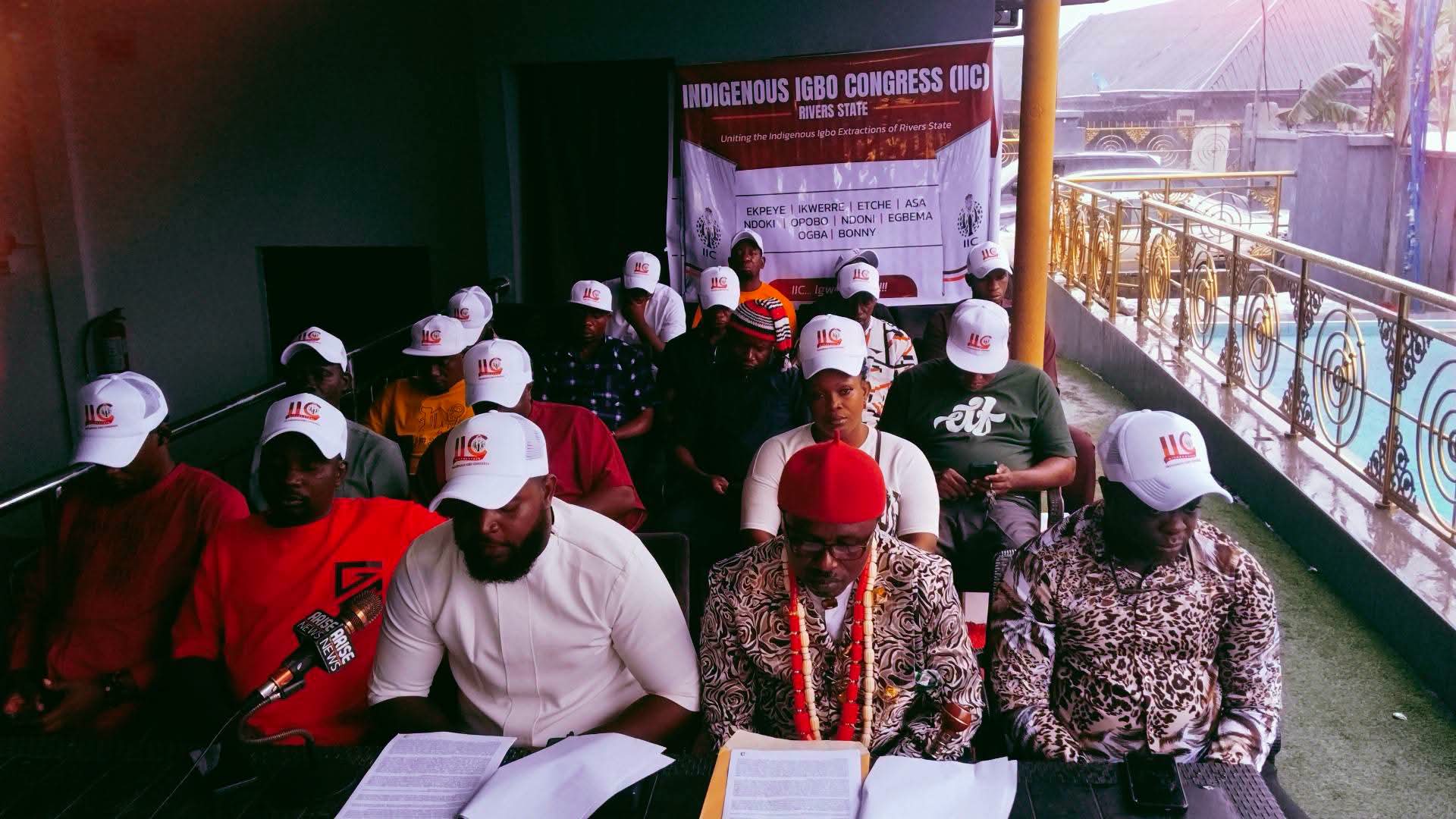
IIC urged the organisers of the concerned citizens assembly, where the regionalisation matters are being discussed, to realise that what is being negotiated in those conference rooms is not merely the architecture of a federation; it is the fate of a language, a culture, and a civilisation, and a people does not negotiate its own erasure.
They said that they have taken careful note of the ongoing discussions and proposals concerning a possible national restructuring of Nigeria and of the several models being advanced for the political and administrative reorganisation of the Federation at the conference now in session under the aegis of the Concerned Citizens Assembly.
“We welcome every genuine effort aimed at addressing Nigeria’s long-standing political, economic, constitutional and structural challenges. We say this without irony and without reservation: this country needs honest surgery, and we are not among those who fear the knife.”
They, however, warned against ambiguity, stressing that before Nigeria and before history: no restructuring arrangement, however elegant, however urgently procured, shall be employed as a vehicle for the balkanisation, fragmentation or arbitrary dismemberment of the historical and cultural homeland of the Igbo people.
“That is our red line, and it is drawn not in conference ink but in the settlement of centuries of speech, kinship and sacrifice upon this land,” IIC said.
Drawing Facts/Truth From History About Their Identity
The IIC said that as the common voice of its people, it wishes to clarify patiently, documentarily, and once and for all the arguments now being advanced about the identity and history of the peoples placed inside the proposed “Rivers Region”.
According to the group, “Our Igbo origin has never been in doubt. We are part and parcel of the Igbo race and civilisation, and this is evident in our culture, in our language, and in our systems of traditional administration.
“The so-called delegates of the proposed Rivers Region are, therefore, misrepresenting the identity of the people not upon evidence, but upon the wounds of a distorted politics. The record says otherwise, and the record is not ours alone.
“The scholars of the colonial era said so. The early ethnographers of the Eastern Niger Delta, Percy Amaury Talbot, author of The Peoples of Southern Nigeria (1926); G. T. Basden of Among the Ibos of Southern Nigeria (1921); G. I. Jones; Audrey Smock; and Daryll Forde, co-author with Jones of the ethnographic survey The Ibo and Ibibio-Speaking Peoples of South-Eastern Nigeria (1950), recorded our Igbo identity as a matter of observation, not argument. The archives said so.”
IIC explained that the colonial anthropological reports of its several court areas, compiled as far back as the late 1920s and the 1930s and preserved to this day in the National Archives of Nigeria, contain the recorded testimonies of its fathers on precisely this question.
“Our fathers said so under oath. In the hearings that considered the creation of Rivers State between the late 1950s and the early 1960s, Chief Joseph Wobo of Rebisi maintained without hedging that the people from Port Harcourt to Onitsha were one people.
“And when the Commission Appointed to Enquire into the Fears of Minorities and the Means of Allaying Them (1957–1958), remembered in history as the Willinks Commission, sat to hear the peoples of the Rivers country, our people were represented as Igbo, and this was disputed by no dissident voice such as those speaking now.
“The Commission’s own report, paragraphs 4–6, records: ‘The former Rivers Division also includes over 300,000 Igbos, of whom 250,000 are in Ahoada Division and 45,000 in Port Harcourt.’
“Port Harcourt is a town of recent growth and of rapidly increasing importance; it is built on land that belonged originally to an outlying branch of the Igbo tribe, the Diobus, but is largely inhabited by the Igbos from the interior who have come to trade or seek employment.
“Of the total 747,000 in the Rivers province, 305,000 are indigenous Igbos, 240,000 are Ijaws, and 156,000 are Ogonis.”
IIC said that the strip to the south of the Igbo block is physically divided by a block of Igbo territory, tipped by the important Igbo town of Port Harcourt and tribally divided between the Ijaws and the Ogonis.
“In the whole of this non-Igbo area there is present in varying degrees some fear of being overrun, commercially and politically, by the Igbos.
“If Ahoada and Port Harcourt, which are really Igbo, are considered with the solid centre of the Igbo population, there are 54 seats for the Igbo area and 30 for COR (Calabar, Ogoja and Rivers) in the Eastern Regional House of Assembly.”
“A commission convened to hear the fears of minorities counted us among the majority Igbo, and no man rose to contradict it. Our founding statesmen said so. Chief Jackson Aleruchi Omekwe Mpi Ikwunga of Nkarahia-Isiokpo stood before the Willinks Commission in 1957/58 shoulder to shoulder with Joseph Wobo of Diobu, E. J. A. Oriji of Emohua and J. H. E. Nwuke of Etche, a single delegation of the Igbo-speaking region of the then-proposed Rivers State.”
IIC went on to ask that if its people were not Igbo, those men in history mentioned above instrumental in the creation of Rivers State and revered in its history had before them the once-in-a-generation stage upon which to declare it.
“The Willinks hearings were the very window of emancipation for the minorities of the East. Our fathers said the opposite, and they said it together.
“The consequences prove it. It was precisely because the Etche, the Ọgba, the Ekpeye, the Ikwerre and their brethren were Igbo, part and parcel of the majority, that they were exempted from the remedies of the Willinks Commission.
IIC said that when special areas were designated for the minorities of the Rivers, only the Ijaw, the Ogoni and other Niger Delta groups were named beneficiaries; the Igbo-speaking group of the Rivers was left out for one reason only: a commission for minorities cannot compensate a majority.
According to IIC, “In 1961, when the defunct Niger Delta Development Board (NDDB) was created to cater for the oil-producing minority areas, the oil-producing Ikwerre communities were excluded from its benefits even though the Board’s headquarters stood on Ikwerre ground.”
IIC said that it was for the above reason that Chief Jackson Aleruchi Omekwe Mpi, head of the Eastern House of Chiefs, threatened to seize the facility itself, since it’s being sited within his Port Harcourt Ikwerre territory.
“Our public men have said so, generation after generation. Senator Obiajunwa Wali, scholar, federal legislator, and one of the founders of the Ogbakor Ikwerre Convention, a man felled by assassins in 1993, identified with the Igbo until he disagreed with Dim Chukwuemeka Odumegwu-Ojukwu over the prosecution of the Civil War, waged against the counsel of Prophet Sam Wobo, who had advised against it in 1966.
“Note well: that was a quarrel about the conduct of a war, not about the identity of a people. Okogbule Wonodi, the first Ikwerre poet and a registrar by profession, and Eze Risiohia Emeru stood among the founding members of Nzukọ Igbo and Ọanaeze Ndigbo.
“Chief Emmanuel Aguma, the first Ikwerre representative in the Eastern House of Assembly (1961–1968), remained a member and founding father of Ọhanaeze Ndigbo until his death.
“Senator Francis Ellah of Ọgba and Chibudom Nwuche of Ekpeye, two of the most consequential public figures our soil has produced, have remained instrumental in the apex Igbo sociocultural organisation.”
IIC said that representation of its people as “distinct minority groups” within Nigeria as against their identity in the majority Igbo was never a discovery of scholarship.
According to the group, it was an adaptation to the realities of a Nigerian federalism that chose to fragment the Igbo-speaking region, as seen in the prolonged marginalisation of the Igbo-speaking groups of the Rivers Region, from the days of the Willinks Commission, through the NDDB (Niger Delta Development Board), into the early years of Rivers State itself.
“It was under this whip that bodies such as Ogbakor Ikwerre emerged in 1963, among others, to foster directly and remotely the interests of the people as distinct groups; that the famous 1965 declaration at Rumuomasi voiced the interests of the Iwhuruohna simply as Iwhuruohna, and not as a subset of a larger majority bloc; for the Igbo-speaking groups of the peripheral provinces were being marginalised and left out, and a punished people will reach for whatever shield is near.”
IIC recalled that even Obiajunwa Wali, the great activist of minority ethnic rights who carried the grievances of the marginalised groups, Ikwerre among them, to the national stage never surrendered the larger truth.
“It was in faith in our unity and our collective Igbo identity that he championed the creation of a Port Harcourt State for the Igbo-speaking groups marginalised within the newly created Rivers State.
“It was for that cause that he met the Igbo statesmen Nnamdi Azikiwe and Ebitu Ukiwe to solicit their support for the creation and emancipation of the Rivers Igbo through the state-creation movement. The archive, the oath, and the outcome agree. Three witnesses; one testimony. We are Igbo.”
Who Owns Port Harcourt?
According to the IIC, the town of Port Harcourt, a port raised to ship the coal of Enugu and named in 1913 after Lord Lewis Vernon Harcourt, a British politician who served as the Secretary of State for the Colonies, is built on land natively owned by the Rebisi people of the Ikwerre, recorded in the earliest documents under the name “Diobu”: an anglicisation of “Ndiogbu”, the name by which the early Aro settler population knew the people, derived from the Oro-Ogbum sections.
“At the purchase of the land, the British sat with the Rebisi chiefs at Ọnụ-mini Rebisi and entered the place in their documents and maps as Iguọcha, Igwu-Ocha, ‘the Peak of the Whites’, or Ugwu-Ocha in central Igbo: the landmark at which a host of Europeans, in numbers such as had never before been encountered, berthed upon the Ikwerre shore.
“Let the linguists note it: ‘igwe’ also means ‘crowd’ and is cognate with ‘igwu’ and ‘igwuru’, which carry the same meaning.”
IIC said that the city was then built after the relocation of the aborigines and upon their meagre compensation.
“The British transacted through interpreters drawn from the riverine area, peoples who had enjoyed earlier contact with Europe and included non-Ikwerre groups; certain of these were entered as beneficiaries in the acquisition of Port Harcourt, among them settlers in the fishing camps who stood in customary tenancy to the Rebisi.
“A tenant at the signing of a deed is not thereby its landlord; and indeed, the ownership of the city has been settled, again and again, in previous court cases won by the Ikwerre.
“Let the truth be told plainly about the hunger for this city. Port Harcourt was the prize for the proponents of the Rivers State creation movement of the early 1960s, led by the Rivers Ijaw People’s Congress; it was for this reason that its members lobbied for the inclusion of the Rebisi and other Ikwerre sections within that movement, a movement which, at one stage, even sought to sweep in the Ijaw populations of the defunct Mid-Western Region (present Delta State and parts of present Bayelsa State), until that overreach was opposed.”
IIC said that the same interest in the city fuelled the opposition that met the late Senator Obiajunwa Wali’s movement for a Port Harcourt State.
“Over the decades, the indigenous people have surrendered ancestral lands to development and industrialisation to the port, to the refineries, and to the estates of state and have received in return little or nothing.
“What our fathers gave, they gave for Nigeria. What remains, we will not give. Not one inch of the territories covered by this Congress will be ceded not now, not at any conference, not on any map.”
The Map Of The Proposed Rivers Region
According to the IIC, “The proponents of restructuring, having claimed to redraw Nigeria along ethno-linguistic regional lines, are hereby invited politely, and then not politely, to be governed by their own philosophy.”
IIC said it is double standards of the most transparent kind to weigh ethno-linguistic factors in some places and to suppress them in others.
According to them, the proposed “Rivers Region” fails its own founders’ test at the threshold of its own name: it reflects no ethno-linguistic consideration whatever.
IIC said that it is unfortunate that the proponents of the region propose to place its Ogoni neighbours, a distinct nation with a distinct language, as minorities inside a region that would be predominantly Igbo.
“We, therefore, urge the proponents to redraw the maps and to address the fears of the minorities, and we call, in the spirit of good neighbourliness, upon the Ogoni nation to speak up as loudly as their founders spoke for the survival and emancipation of the Ogoni people, as championed by the founders of MOSOP led by the activist Ken Saro-Wiwa, who in 1995 paid with his life for that speech.
“We strongly oppose the balkanisation of the Igbo ethno-linguistic area into three regions at the very moment that the Yoruba, the Ijaw, the Hausa, and our neighbouring Ibibio-Efik-Annang-Oro-Ekid-Obolo clusters would each be granted one region apiece.”
IIC went on to say that what should be guaranteed to all Nigerians is one nation, one region, stressing that if the Igbo alone must be divided into three, let the conference explain to Nigerians and to the world why.
The group went further to say that such balkanisation reveals a deliberate attempt further to diminish Igbo cultural influence and to alienate Igbo from their identity, corroding in the long run their language and their culture.
“It is visible already in the spectacle of the supposed delegates of the proposed Rivers Region insisting that we are minorities made up of different peoples. Consider the arithmetic of those delegates.”
IIC said that it is insane that a people who looked upon the Ndọni, the Etche, the Ọgba, the Ekpeye, the Ikwerre, the Ndọkị and the Asa peoples bound together by one intelligible language family and one culture and pronounce them different peoples entirely will in the same breath applaud the folding of three linguistically unrelated groups, Delta Cross, Ijoid and Edoid, into a single proposed Ijaw region.
It stressed that if one intelligible language does not make one people, how do three unrelated languages make one?
“This is not geography; it is special pleading. We say this without contempt, for the delegates are our own people of the Rivers Region, and their condition is our indictment of the federation that produced them.
“Their attitude is the harvest of what balkanisation and marginalisation planted: a full-blown identity crisis and an inferiority complex that have pressed many of our people to assert themselves as anything at all, anything, but Igbo.
“In the 1970s, at the height of the marginalisation that followed the creation of Rivers State by military decree in May 1967, when pro-Igbo voices were being silenced, there sprang forth ridiculous, false and distorted versions of our histories, some of them supplied by the Rivers delegation itself.
“We saw the derecognition of the stool of Chief Jackson Mpi, the first-class chief of the Ikwerre. We saw the dethronement of Samuel Uwakwe Ogan, the Amanyanabo of Okrika, a king of Igbo descent, and of King William Dappa Pepple of Bonny, among others.”
IIC says it still remembers the military clearance that the Igbo of the East-Central State required merely to return to Port Harcourt, a man needing a soldier’s paper to walk back into the city his fathers had sold to the British.
“We remember a war whose aftermath taught our fathers that to survive was to deny the name Igbo, and the trauma has haunted the present generation for decades after the last shots of January 1970. The IIC says it exists to end that haunting.
“To the delegates, therefore, we leave the words of the late Senator Obiajunwa Wali himself on the question of distorted history: ‘…in telling our stories we must avoid fairy tales, dreams and illusions…the twisted and senseless interpretation of history.'”
IIC Begins Correction of History Anchored on Research
IIC says it has commenced a comprehensive programme of academic, scholarly, historical and archaeological research and documentation to publish objective histories of the different Igbo-speaking groups of Rivers State anchored in the archives, in the archaeology, in the linguistics, and in oral tradition rigorously weighed to counter the false narratives being circulated about its people; chief among them is the insinuation that they are descendants of fugitives of Bini ancestry.
“Let scholarship trace the smuggling of that fable, for it has a receipt. It entered our history in 1975, through one D. A. H. Emejuru, backed by Bekweri Wosu and the Wezina addition, in their fight against the story of Arochukwu origin as told by Amabebe Nsirim of Isiokpo.
“The Benin fable itself drew breath from the 1952 work of D. O. Ewoh, ‘The History of Ogba and Their Culture’, a book shaped by stories told by migrants into Ogbaland from Aboh, Oguta and Ossomari and from the works of J. U. Egharevba, the Benin historian, who mentioned the name Ogba among the towns that existed in the days of the Ogisos, in ‘A Short History of Benin’ (1934) and ‘Benin Laws and Customs’ (1946).”
“From these slender threads, whole garments have since been sewn: the accounts have multiplied; some writers have begun attaching even the Etche and the Ndọkị to Bini migration tales; and most recently a revisionism has arisen that would reassign Wagidi, the prominent war leader of Arochukwu origin enshrined in Ikwerre memory, to a Bini ancestry.
“All of it serves a single objective: the denial of our Igbo identity. We call upon all who profess loyalty to authentic, scholarly and objective historiography, the universities, the archival services, the archaeological missions, the custodians of oral tradition, researchers of every method and every nation to enlist in this endeavour. Bring your evidence; we fear nothing that is true.”
The Demand Made By IIC
IIC said that further balkanisation of the Igbo region will only prolong the historic-cultural and ethnolinguistic identity problems we now endure.
The IIC, therefore, declares and requires the conference to record the following non-negotiable positions: The entire territories of the Ọgba, Ekpeye, Ikwerre, Etche, Ndọni, Ndọkị Asa and Egbema peoples must be included, whole and undivided, in the proposed Igbo Ethnolinguistic Region.
“The following Igbo communities, now allocated to the proposed Ijaw, Cross-River, Edo, Akwa Ibom, Ane-Igala and Apa-Agatu regions, must be retrieved and restored to the Igbo Region: from the proposed Ijaw Region, Abuetor and Osekwenike; from the proposed Cross-River Region, Isobo-Bikobiko; from the proposed Edo Region, Igbanke; from the proposed Akwa Ibom Region, Ọhaobu-Ndọkị of Ukanafun; from the proposed Ane-Igala Region, Akpanya and Eke-Avurugo; and from the proposed Apa-Agatu Region, the Igbo country of Benue State: Umuezekoha, together with the indigenous Izzi and Ezza communities.
“We mince no words: any regional arrangement that denies the Igbo-speaking peoples, including those of present-day Rivers State, a single region of their own is Dead on Arrival.”
The IIC says it will resist, by every legitimate and constitutional means, any attempt further to balkanise or sideline the indigenous Igbo people of the frontiers.
On Bonny & Opobo: The Umu Ubani
IIC urged the proponents of restructuring to reconsider the status of the Bonny and Opobo areas, presently placed within the proposed Ijaw region.
IIC says it is no news, except, apparently, to the draughtsmen of these maps, that the two areas are key points on the Igbo linguistic map and were among the first places where the Igbo language was captured by Europeans, in documents published as early as the late eighteenth century.
“The people of Bonny and Opobo themselves speak the Igbo language and are known as Ụmu Ubani, the children of Ubani. The Igbo language has existed on those islands since antiquity, and a significant proportion of the people are of Igbo descent.
The Igbo have been on the island of Bonny from antiquity, as corroborated in the oral traditions recorded by the Europeans and restated in the press release of 29 January 2022 by the Bonny United Front: ”
For the umpteenth time, Bonny Kingdom has a rooted Igbo origin and culture. Our origin tells of two major migrations into the Rio Real. One version tells of an origin from Alagbariya, a great hunter from the Igbo hinterland, and another version of migration from Kolokuma.
“The spoken Igbo language is unique to us and has been in Bonny since antiquity, same as Ibani-Ijaw. No one knows which group came first, nor do we know which language was first spoken.
“But what we know of ourselves is that we are unique in culture, which has made Bonny great…While the majority of our houses were changed to Ijaw-styled names, the main language remains Igbo.
“This does not relegate Ibani, which is spoken in Bonny, nor does it mean that Igbo names and houses do not exist as well.
“In Opobo, the town founded by an Igbo man, Okwara Mbanaso of Amaigbo, the great merchant whom history crowns as King Jaja and whom the British seized into exile for his independence, the same truth applies in much greater evidence.”
The IIC, therefore, urges the proponents to completely throw away those mapping and recommends an arrangement that reflects the historical and linguistic realities of these places rather than mere political convenience.
It says that to place Igbo-speaking communities wholly inside an Ijaw region would be ironical; yet to place areas of Ijaw cultural influence wholly inside another region may be no more appropriate.
“Let the restructuring committee devise a favourable regional arrangement for Bonny and Opobo, one that honours both their Igbo historical and linguistic heritage and their Niger Delta cultural ties, in direct consultation with the Ụmu Ubani themselves.”
IIC says that their geographical isolation from the rest of the Igbo ethnolinguistic area notwithstanding, as any one-sided arrangement will be resisted.
IIC stressed that Igbo land is more than administrative boundaries and called on the Federal Government, political leaders, traditional institutions, civil society organisations, ethnic and cultural bodies, and all stakeholders who may participate in any proposed restructuring dialogue to approach the question of territorial and political restructuring with historical responsibility, constitutional fairness, and respect for the legitimate interests of indigenous communities.
“Consider what a boundary is. The present boundaries of Nigeria’s states and local government areas are artefacts, products of successive political and administrative arrangements, drawn and redrawn by proclamations, decrees and gazettes.
“They must not, therefore, be automatically treated as the immutable boundaries of indigenous identities, ancestral territories, historical relationships or cultural communities.
“The Igbo people have historically maintained extensive networks of kinship, of language, of culture, of traditional institutions, of migration, of commerce, and of inter-community relations, extending across territories that present-day paperwork divides among different states.
“A language does not observe a state boundary; neither does a grave. Consequently, any restructuring exercise that seeks to redraw Nigeria’s political map must not begin from the assumption that existing state boundaries necessarily constitute the limits of Igbo identity or historical territory. Administrative boundaries must never be allowed to erase historical realities.”
It says that its position in Rivers State is that of coexistence and not of amputation, stressing it rejects, wholly, any restructuring proposal that seeks deliberately to isolate, detach or politically sever indigenous Igbo communities and their historical relationships from the wider Igbo cultural and historical family, merely because those communities presently fall within Rivers State or any other administrative jurisdiction.
“We recognise Rivers State as a constituent part of the Nigerian federation, and we respect, genuinely, and without calculation, the rights and identities of all its indigenous peoples and communities.
“Our own proverb teaches: “Egbe bere, ugo bere; nke si ibe ya ebela, nku kwaa ya (let the kite perch, let the eagle perch; but whichever forbids the other the branch, let its wing break).
“We wish to perch. We wish every Ijaw and Ogoni neighbour to perch. Neither person wishes the other’s wing broken. But the existence of Rivers State as a political entity does not, in itself, extinguish the historical, cultural, linguistic and ancestral relationships of communities whose identities and historical connections transcend contemporary state boundaries.
“We therefore oppose any attempt to employ restructuring as an instrument of “divide and rule” ethnic engineering, particularly where such an arrangement would permanently fragment communities without meaningful consultation with the affected indigenous populations.”
It went on to warn that there is nothing like restructuring without the people, as any credible restructuring conference must place the principle of self-determination, consultation and democratic participation at the centre of its deliberations.
IIC said that no community should have its historical identity, political affiliation or territorial future determined exclusively by political elites sitting in distant conference rooms and gave seven conditions that must be met for restructuring.
“We consequently demand that any restructuring process include: Meaningful consultation with indigenous communities directly affected by proposed boundaries or political changes; Recognition of historical, cultural, linguistic and ancestral relationships alongside contemporary administrative boundaries; Transparent and evidence-based examination of competing territorial and historical claims; Protection of minority rights and safeguards against the domination or political absorption of indigenous communities; The right of affected communities to participate directly in determining their political future; An independent historical and ethnographic review wherever competing claims concerning identity, ancestry and territorial belonging exist.”
IIC said that its position must not be misconstrued as opposition to national dialogue or to restructuring, because on the contrary, it strongly supports a genuine restructuring process capable of producing a more equitable, peaceful and functional Nigerian federation.
“We believe Nigeria urgently requires serious conversations on true federalism, devolution of powers, fiscal federalism, resource control, regional development, constitutional reform, security architecture, local autonomy and equitable political representation. But restructuring must not become a euphemism for territorial balkanisation.
“A nation that seeks justice cannot, in the same breath, create new injustices through the arbitrary fragmentation of historically connected peoples. When the map and the truth disagree, it is the map that must be redrawn.”
The group went on to appeal to Igbo leaders everywhere, both political leaders and traditional rulers, intellectuals, scholars, community organisations, youth organisations and cultural institutions across Nigeria and in the diaspora, to approach the restructuring question with vigilance and with unity.
“We urge all stakeholders to move beyond partisan political calculations and to engage this issue from the perspective of long-term historical, cultural and generational interests.
“The present generation bears a responsibility not to make irreversible territorial decisions on behalf of generations yet unborn without adequate consultation, research and consensus with the Federal Government.
“The Federal Government must ensure that any proposed restructuring conference is genuinely inclusive and does not become a mechanism through which predetermined territorial outcomes are presented to Nigerians as faits accomplis.”
IIC demands that all proposals affecting the territorial, cultural or political interests of indigenous peoples be subjected to open scrutiny and consultation.
“No restructuring conference possesses the moral or democratic authority to redraw the identities and historical relationships of entire peoples without their meaningful participation.”
The IIC of Rivers State added that it remains committed to peaceful advocacy, intellectual engagement, historical research and constitutional dialogue.
It says it shall continue to engage constructively with all ethnic nationalities and communities in Rivers State and across Nigeria in pursuit of justice, peaceful coexistence, and a federation in which every indigenous people can preserve its history, its culture, its identity, and its legitimate interests.
The IIC says it believes that unity does not require the destruction of identity and that restructuring must not require the fragmentation of historical peoples.
The IIC calls on the organisers and participants of any proposed restructuring conference to withdraw, reconsider, or substantially revise any proposal that would amount to the balkanisation of Igbo land or the arbitrary severance of historically connected Igbo communities.
“We remain ready to participate in any credible national dialogue founded upon truth, justice, historical evidence, democratic consultation and mutual respect. The future of Nigeria must be negotiated, not imposed.
“The history of a people must be respected, not administratively erased. And restructuring must unite Nigeria through justice, not divide its peoples through political engineering. We remember. We resist. We remain.”
END


