







In what proved to be drastic U-turn of domestic entrepreneurship, the Ministry of Labour and Empowerment in Nigeria’s South-West Zone has adopted in the One Kindred One Business Initiative (OKOBI), introduced by Governor Hope Uzodimma.
OKOBI, is a brainchild of Hope Uzodimma, the Governor of Imo State, who launched the initiative in 2023 as a pragmatic response to unemployment and grassroots economic stagnation.
At its core lies a simple but potent idea: small, trust-based groups—typically between two and ten individuals—should be supported to form cooperatives and run viable businesses.

These enterprises are deliberately modest in scope but high in relevance, spanning poultry farming, cassava processing, fish farming, palm oil production, and small-scale manufacturing
Prince Eze Ugochukwu, Special Assistant to Governor Hope Uzodimma on Public Communications said that the adoption by South West is more than a routine policy expansion; it is a decisive endorsement of one of the country’s most intriguing home-grown economic experiments.
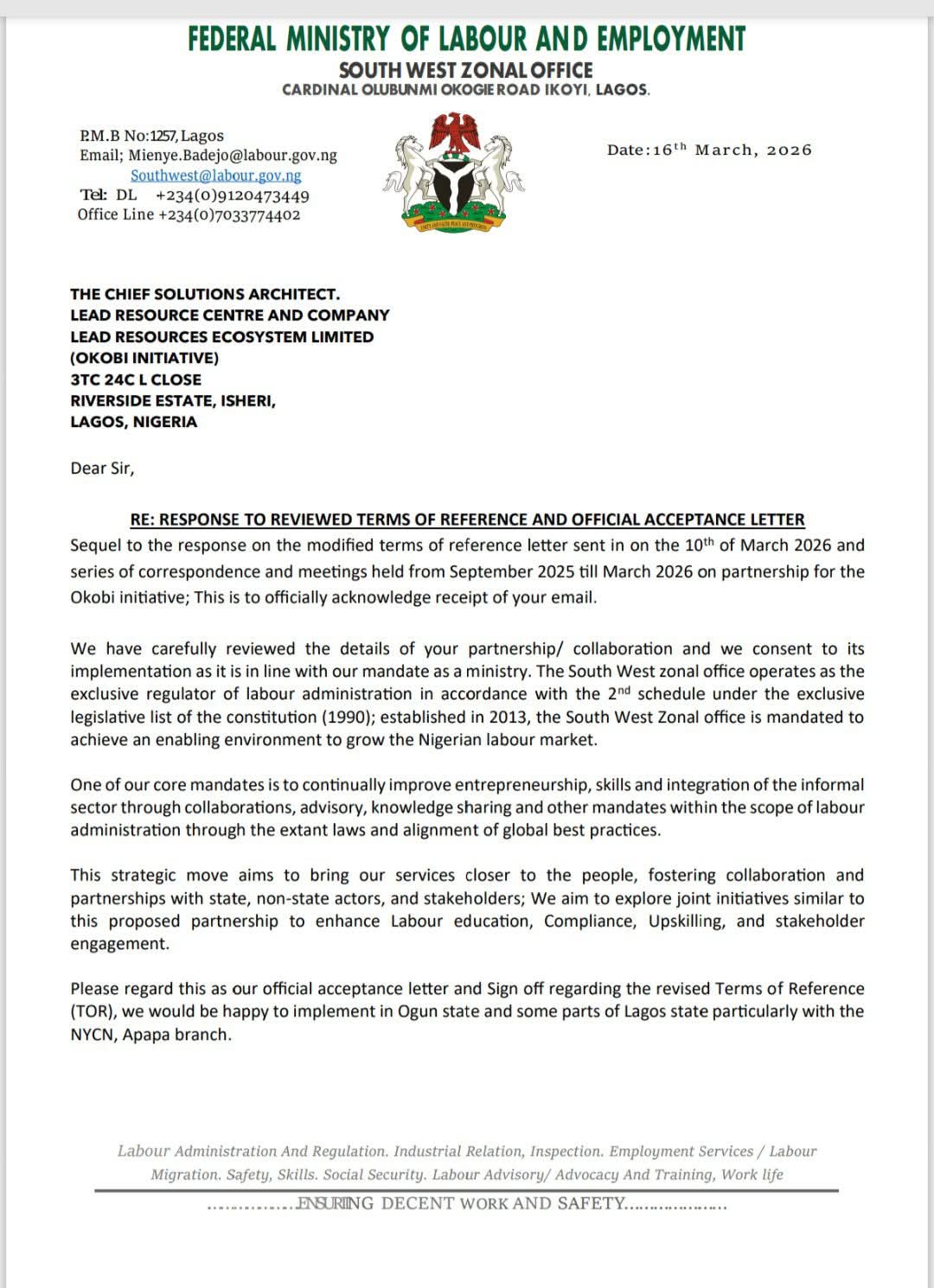
He said that when the Federal Ministry of Labour and Employment, through its South West Zonal Office in Lagos, formally signalled its acceptance of a partnership to extend OKOBI into Ogun State and parts of Lagos, it effectively validated the initiative as a model worthy of national replication.
Ugochukwu said that in a country often divided by policy inconsistency and regional scepticism, such cross-regional uptake is rare—and significant.
He added that the intellectual foundation of OKOBI draws from the Igbo concept of “Umunna”—a system of kinship and mutual obligation. “Yet, its growing appeal lies precisely in its ability to transcend that cultural origin.
“The South-West’s embrace of the model underscores a broader truth: while OKOBI may be rooted in Igbo social structure, its logic is universal. Trust, cooperation, and shared economic purpose are not exclusive to any one ethnic group; they are the building blocks of functional economies everywhere.”
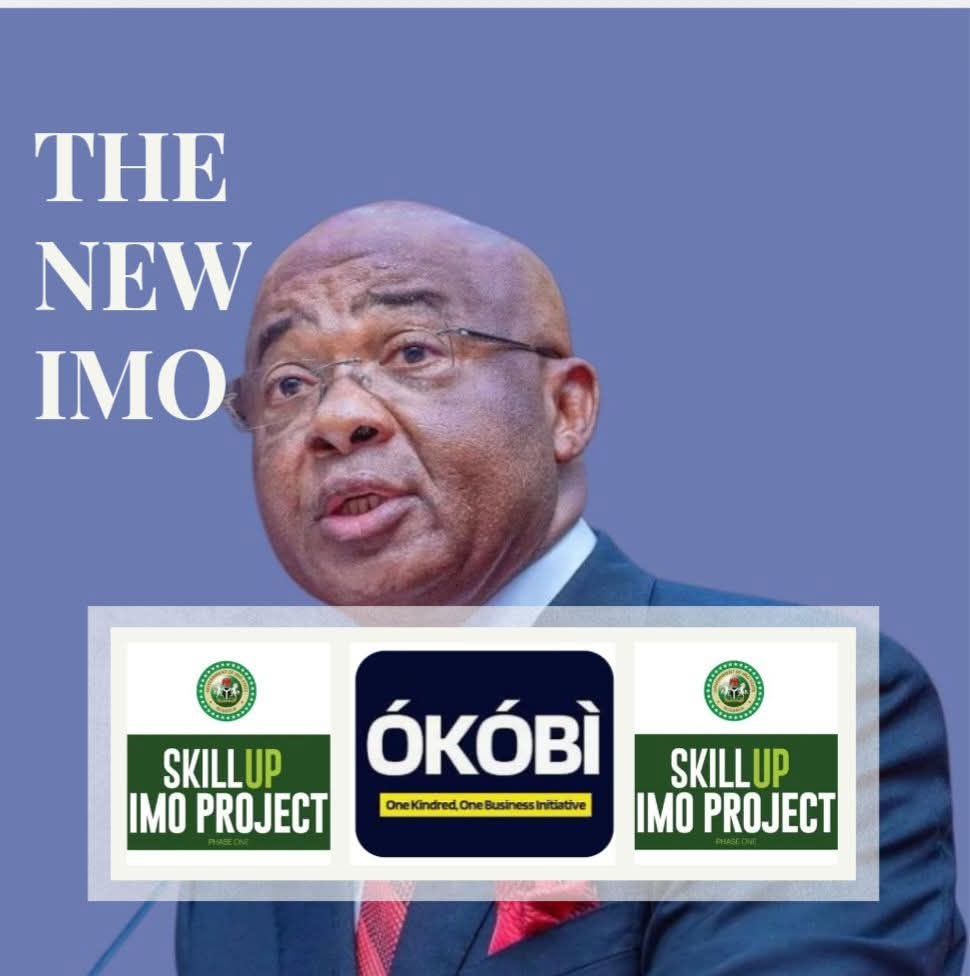

He said that what distinguishes OKOBI from previous government-led interventions is its structural clarity and operational discipline, as the Imo State government does not attempt to run businesses directly.
“Instead, it plays the role of an enabler—facilitating cooperative registration, providing mentorship, offering tax incentives, and creating access to competitive grants of up to ₦5 million. This approach reduces entry barriers while preserving local ownership, a balance that has eluded many public-sector programmes.
“The results in Imo State have been striking. Within a relatively short period, the initiative has generated over 460 cooperative businesses involving nearly 20,000 participants.
“Beyond the headline figures, however, lies a more important transformation: the gradual formalisation of informal economic activity. Small producers who once operated in isolation are now embedded in structured networks, improving productivity, market access, and resilience. Women and young people—often the most economically vulnerable—feature prominently among the beneficiaries.”
Ugochukwu said that it is this demonstrable impact that has attracted attention beyond the South-East. Adding that for the South-West, a region with its own complex economic landscape, the adoption of OKOBI represents both an opportunity and a test.
“Ogun State and targeted parts of Lagos, including the NYCN Apapa axis, will serve as early proving grounds for how well the model adapts to different social and commercial dynamics. If successful, it could trigger wider adoption across the region and beyond.
“More interestingly, this development introduces the prospect of healthy inter-regional competition. Nigeria’s federal structure has long struggled to foster constructive rivalry among its constituent states.
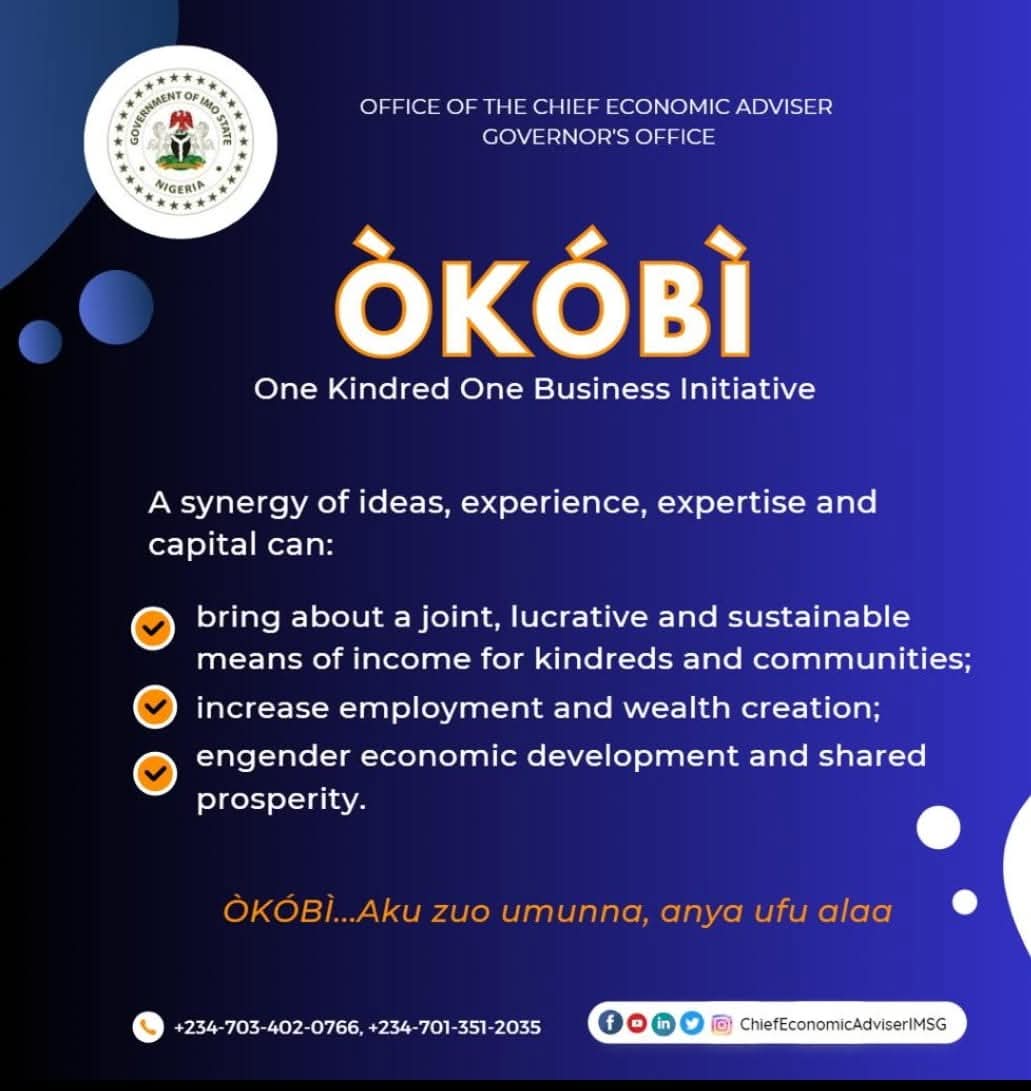

“Too often, competition has been political rather than productive. OKOBI offers a different template—one in which states compete on their ability to create jobs, support small enterprises, and empower communities at the grassroots level.”
He said that such competition, if sustained, could be transformative. As the South-West begins to implement and potentially refine the OKOBI model, other regions may feel compelled to respond—not out of obligation, but out of necessity.
“The question will no longer be whether a state has an economic programme, but whether that programme delivers measurable outcomes comparable to its peers. In this sense, OKOBI could become less a singular initiative and more a national benchmark.”
He added that the federal government’s involvement further amplifies this dynamic. He noted that aligning OKOBI with labour administration priorities—such as skills development, informal sector integration, and employment generation—the Ministry of Labour and Employment is effectively integrating a state-level innovation into a broader national framework.
“This not only lends credibility to the initiative but also increases the likelihood of institutional continuity.
“There are, of course, challenges ahead. Scaling a model across regions with different cultures, governance styles, and economic conditions is rarely straightforward. What works in rural Imo may require adaptation in urban Lagos.

“Issues of coordination, accountability, and funding will inevitably arise. Yet, these are not insurmountable obstacles; they are, rather, the natural tests of any policy seeking national relevance.
“Indeed, the early signs suggest that OKOBI is already evolving. The establishment of joint working groups, the development of implementation timelines, and the emphasis on stakeholder engagement in the South-West indicate a level of planning that goes beyond mere replication.
“If anything, the process may strengthen the model, introducing new efficiencies and innovations that can be fed back into its original base.”
Ugochukwu said that international interest adds another layer of momentum, as partnerships with organisations such as Calpe Partners USA and Africa Business Affairs (AfriBA), alongside exposure at global economic forums, point to the possibility that OKOBI could eventually serve as a template beyond Nigeria.
He said that projections of substantial economic impact—running into hundreds of billions of naira over the next few years—may be ambitious, but they are not implausible if adoption continues at scale.
“For now, however, the most important development is domestic. The South-West’s embrace of OKOBI signals a shift in how Nigeria approaches economic problem-solving. It suggests a growing willingness to look inward—to identify, test, and replicate ideas that work, regardless of where they originate. That, in itself, is a quiet but meaningful revolution.”
He said that OKOBI may have been conceived in Imo State by Hope Uzodimma, but its journey is no longer confined there, as it takes root in the South-West, it is beginning to reshape the contours of economic collaboration in Nigeria—turning regional diversity from a source of division into a platform for shared progress.
“If that trajectory holds, the initiative will have achieved something rare: not just the creation of businesses, but the creation of a model that compels a nation to compete, cooperate, and ultimately grow together,” he said.


