
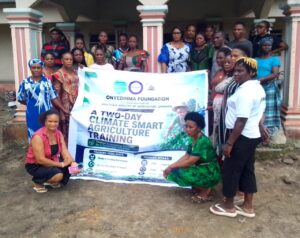




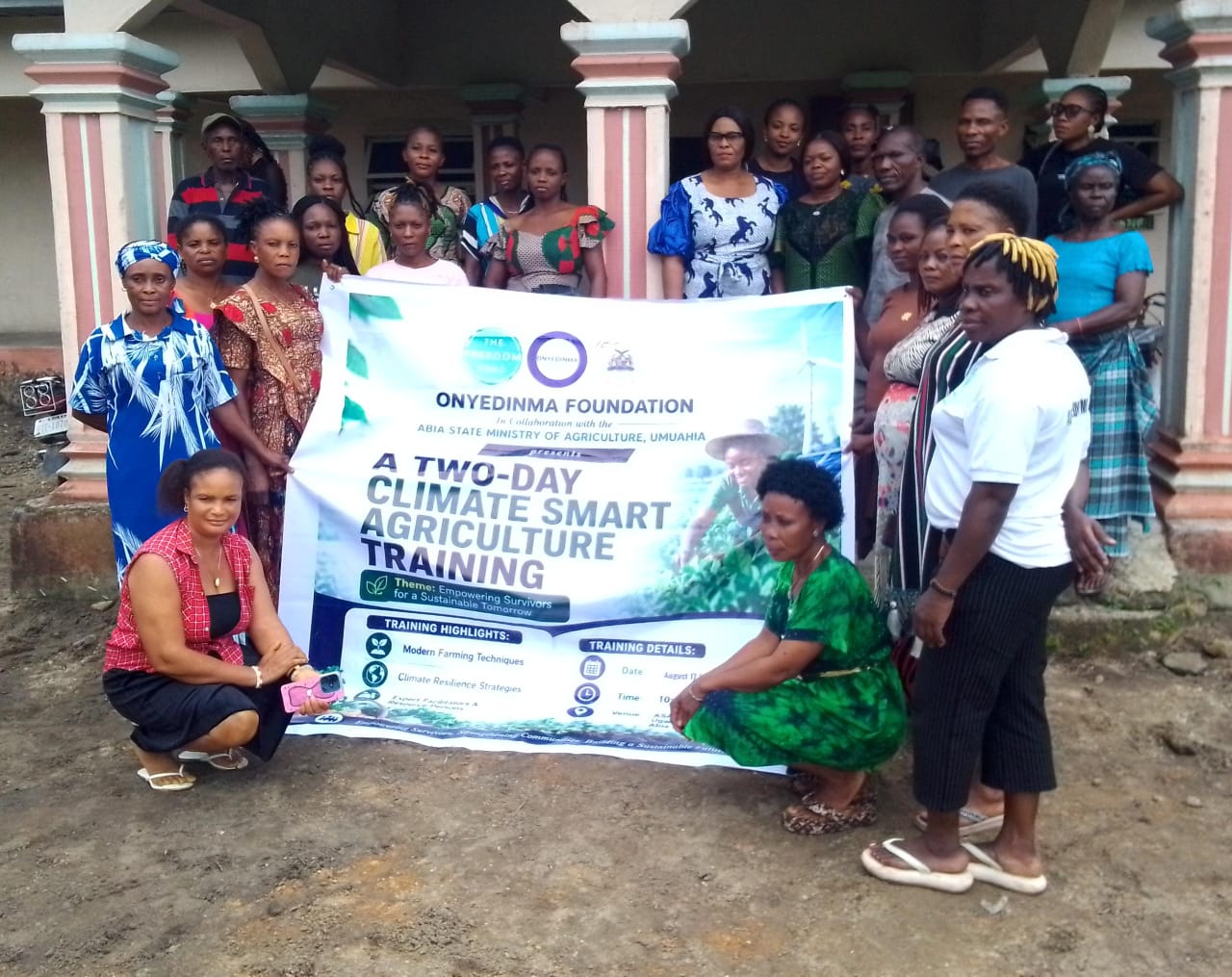
The Onyedinma Foundation, in partnership with the Agricultural Development Programme (ADP), has successfully concluded a two-day Climate-Smart Agriculture Training at the Asa-Umuakwa community in the Ugwunagbo Local Government Area.
The training with the theme “Empowering Survivors for a Sustainable Tomorrow”, was supported by ‘The Freedom Fund’ and brought together farmers, women, and youth participants from Ugwunagbo and neighbouring communities.
During the two-day training, participants were equipped with practical, climate-resilient agricultural skills to improve food security, livelihoods, and community resilience.
With three facilitators from the Agricultural Development Programme (ADP) handling topics like Climate, Planets & Agriculture; Poultry & Smart Climate Practices; Pepper Production; Modern Farming Techniques; Poultry Management & Production; and Climate Smart Vegetable Production.
Tutoring the participants on “Climate, Planets and Agriculture”, facilitator Mrs Nkemjika Nzeka told the participants that agriculture ought to be the backbone of Nigeria’s economy, as it has the capacity to provide 70% of jobs for the unemployed population of the country and contributes to the GDP.
However, Nzeka said that despite the obvious capacity agriculture has, it is currently being impacted negatively by climate change. She made them understand the issue of global warming, a long-term rise in earth’s average surface temperature driven by human activities causing widespread environmental changes.
Enlightening the participants on the effects of global warming/ozone layer depletion, stressing that global warming does not just mean hotter summers but reshapes the entire climate system.
She said that effects like extreme weather, sea level rise, ocean acidification, and biodiversity loss equally cause agricultural disruption, as changing rainfall patterns affect food production and water supply.
Nzeka said that climate-smart agriculture (CSA) is the way out, describing it as a modern farming approach designed to simultaneously boost productivity, strengthen resilience to climate and reduce greenhouse gas emissions.
Touching on the adaptation method to climate-smart agriculture, she said that conversation agriculture, with practices like minimal soil distribution, crop rotation and cover crops, improves soil fertility. She also added that smoulder weed protects plants from heat and reduces erosion.
Speaking on efficient water management, she said that techniques like drip immigration, rainwater harvesting and mulching conserve scarce wat resources.
Other areas touched include agroforestry, improved seed varieties, integrated pest management, diversified farming systems, and soil testing to ensure balanced fertiliser use, prevent waste, and improve productivity.
Teaching on climate-smart livestock production with a focus on climate-smart poultry production, facilitator Mrs Chinwe Ogbonna focused on waste management, heat stress management, and using poultry waste as manure.
Mrs Ogbonna said that there is a growing global demand for livestock products, with a negative impact on climate change; increasing temperature, increased climate variability and more frequent and severe extreme events are all threatening the livestock production system.
She, however, said that the livestock sector is a major contributor to climate change, as it is estimated that the sector emits 7.1 gigatonnes of CO₂ equivalent to (CO₂ eq) 18% of the total anthropogenic greenhouse gas (GHG) emissions.
Ogbonna said that, nevertheless, climate-smart livestock solutions can contribute to a reduction of GHG emissions through improved livestock productivity, efficient use of natural resources, carbon sequestration, and integration of livestock into a circular bioeconomy and climate change adaptation.
She listed the negative effects of climate change on poultry production to include, “heat stress in both house and outdoor flocks, reduced egg production, reduction in the quality of eggs, reduced income and profitability, higher morbidity and mortality rate, decrease in food intake, loss of body weight, rise in feed cost, loss of strength and energy, supply of poor quality chicks, and change in taste of poultry meat and eggs.
According to her, climate-smart poultry production is sustainable farming that addresses the demand for food security in the face of climate change while conserving ecological integrity.
Ogbonna said that there are three key pillars of climate-smart agriculture in relation to livestock/poultry production, which include increased productivity, mitigation of greenhouse gas emissions, and adaptation to climate change.
Teaching on “Climate-Smart Vegetable Production” with a focus on pepper, fluted pumpkin and cucumber, facilitator Mr Chigozie Maraizu said that erratic rainfall, high heat effects, pests and diseases all affect vegetable production.
On pepper, he urged the participants to focus on seedling production, with high focus on nursery preparation, bed fumigation, sowing of seeds, shading of beds, watering of beds, and disease and insect control.
Making her opening remarks earlier on the first day of the training, Glory Onwuka, Executive Director, Onyedinma Foundation, said that as a survivor-led organisation, Onyedinma Foundation understands deeply that sustainable freedom is built not only on breaking chains but also on building livelihoods.
She said that it was that understanding that made the foundation take a bold step toward mapping out a training designed specifically for survivors of trafficking in persons, child domestic work, and other forms of modern slavery.
“We recognise the immense strength it takes to rebuild your life, and our mission is to walk alongside you with practical, dignified, and lasting opportunities,” Onwuka said.
The two-day training had a focus on two key pillars of agribusiness: livestock farming and vegetable farming, all within the framework of climate-smart practices that protect both the future of society and the environment.
She said that at the end of this workshop, participants will gain hands-on knowledge in sustainable farming techniques, resource-efficient methods, and business management skills.
She added that more importantly, the participants will each receive starter packs and ongoing assistance to launch or expand their own agribusines.
“We are not just giving you tools; we are investing in your independence, your resilience, and your rightful place as entrepreneurs in your communities.”
She thanked the Abia State Ministry of Agriculture for their invaluable technical partnership and the Freedom Fund for their unwavering commitment to survivor empowerment.
“Together, we are proving that with the right support, survivors are not victims of circumstance but architects of their own destiny,” she said.
A participant, Peace Nwamburuoke, appreciated the Onyedinma Foundation for organising the two-day training, stressing that after the lectures and instructions, she can comfortably boast that she can handle climate-smart livestock production.
“As rural dwellers, we have our own peculiarities, and a lot of challenges are here for some of the people here, especially the females. With the knowledge of these teachings, I’m sure that most survivors will help other younger people not to fall victim to this man’s inhumanity to man.
“Access to education may not be the problem because most of our people are educated, but having enough information on normal ways of survival without indulging in things that lead to regrets is the key for combating this monster.”
On the side of Gift Sunday, another indigene of the community said that having learned a lot about climate-smart vegetable production, she will definitely take it seriously to carve out a real means of survival, at least from the economic and financial hardship bedeviling almost every part of her town.
“If we’ve been getting these types of opportunities, I don’t think anybody in this community will fall victim to these evil trends. Learning how to farm cucumber and pepper is enough of a way of making an income, and anyone who’s making income cannot be hoodwinked into the unfortunate modern-day slavery. So, I’m proud to have participated.”
On her own, Blessing John corroborated the views of the previous participants who spoke but went further to call for the expansion of the training to some other communities to reach out to many survivors.


